• Landing
    • Online Services
    • Mission
    • Watch online
    • In-Person Services
    • Welcome
    • What We Believe
    • Mission Statement
    • In Pictures
    • Our History
    • Meet Our Staff
  • Giving
    • Contact us
    • Get Our Newsletter
    • Job Opportunities
    • Blog
    • Music
    • Christian Education
    • Adult Education
    • Women of Pilgrim
    • Social Justice
    • Called To Care
    • Events List
    • Calendar
    • Upcoming
    • Sign up for activities or volunteering
  • Facility Use
  • Search
Menu

Pilgrim Congregational UCC Bozeman

2118 South 3rd Avenue
Bozeman, MT, 59715
406·587·3690
Seek. Grow. Serve.

Your Custom Text Here

Pilgrim Congregational UCC Bozeman

  • Landing
  • Services
    • Online Services
    • Mission
    • Watch online
    • In-Person Services
  • About
    • Welcome
    • What We Believe
    • Mission Statement
    • In Pictures
    • Our History
    • Meet Our Staff
  • Giving
  • Contact
    • Contact us
    • Get Our Newsletter
    • Job Opportunities
  • Ministries
    • Blog
    • Music
    • Christian Education
    • Adult Education
    • Women of Pilgrim
    • Social Justice
    • Called To Care
  • Events
    • Events List
    • Calendar
    • Upcoming
    • Sign up for activities or volunteering
  • Facility Use
  • Search

Pilgrim Blog

Pilgrim UCC Bozeman Blog

Letters from Paul

July 28, 2021 Pilgrim Congregational UCC
Fabulous Lettering by Caro Wallis license CC BY-NC-ND 2.0.jpg

by Wendy Morical

Over this pandemic period of lay leadership, I have been the recipient of notes and cards expressing appreciation for the role I have played at Pilgrim. The notes I have received, which are collected in a sheaf on my desk, have sustained me through times when the joy of serving our community of faith has faltered. They have been read and reread in times of despondency or isolation. Several have brought tears of gratitude to my eyes. They are cherished as affirmation of my positive intent when I may feel I am falling short of my goals.

In the early days of Christianity, the apostle Paul traveled widely, spreading information about the life of Jesus and encouraging the growth of the Christian movement. Through his letters, he reached out to inspire the early followers of Jesus. In general, these writings to the citizens of Corinth, Philippi, Ephesus, and other hubs of faithful “saints” tell them that he’s thinking of them, give them reminders of how to live faithful lives, and clarify what he had taught and shared. They all end with final greetings of peace and love to the people who love Christ and requests for the letters to be widely shared. While some of the content is admonitory and focuses on specific, archaic tenets of early Christianity, overall, the message Paul sends is positive: Love one another. Stay faithful. Be your best.

I like to think of a striving but perhaps fractious group of average people in Philippi trying to reshape themselves in this new image. Imagine the impact a letter from a dear teacher would have as they struggle to learn to work together and support one another:

Rejoice in the Lord always. I will say it again: Rejoice! Let your gentleness be evident to all. The Lord is near. Do not be anxious about anything, but in everything, by prayer and petition, with thanksgiving, present your requests to God. And the peace of God, which transcends all understanding, will guard your hearts and your minds in Christ Jesus.

Finally, brothers, whatever is true, whatever is noble, whatever is right, whatever is pure, whatever is lovely, whatever is admirable – if anything is excellent or praiseworthy – think about such things. (Philippians 4:4-8, NIV)

Further down the Aegean coastline, citizens of Ephesus heard from Paul with a reminder of what their focus should be as they, too, strove to put these new ideas into practice:

I pray that out of his glorious riches he may strengthen you with power through his Spirit in your inner being, so that Christ may dwell in your hearts through faith. And I pray that you, being rooted and established in love, may have power, together with all the saints, to grasp how wide and long and high and deep is the love of Christ, and to know this love that surpasses knowledge – that you may be filled to the measure of all the fullness of God. (Ephesians 3:16 – 19, NIV)

The people of Thessalonica got perhaps Paul’s most succinct guidelines for living lives of faith:

Be joyful always; pray continually; give thanks in all circumstances, for this is God’s will for you in Christ Jesus. (1 Thessalonians 5:18, NIV)

During our recent times of distance and isolation, we all worked to hold together our fellowship of brothers and sisters in Christ. In many instances, people made calls and sent notes to connect with and support one another. Now that we’re together again, we can hear the testament of people saying how much they or their family member valued the loving outreach from others.

What great power we have in how we talk to and support one another! We are bound in a community of love and nurture; our covenant is to support each other on our individual spiritual paths. As we grow together in the coming months and work to rebuild our church, let’s bring our best, most devoted selves. It’s our sacred duty to celebrate our diversity, which is a source of strength, by affirming and appreciating one another through our words and actions. We can commit to looking for the ‘noble, lovely and admirable’ in our life together, as Paul reminds us to do, and always give thanks for the joy we share.

I close my letter with these last words:
Be happy.
Grow in Christ.
Pay attention to what I have said.
Live in harmony and peace.
And may the God of love and peace be with you. (2 Corinthians, 13:11, The Living Bible)

1 Comment

Awe and "Thank You"

July 21, 2021 Pilgrim Congregational UCC
Loch Awe by ShinyPhotoScotland license CC BY-NC-ND 2.0.jpg

I did not mention Ross Gay’s poem “Thank You” on July 4, but the entire time I was composing the message, his poem was open on a Poetry Foundation tab on my internet browser. By the time I was done with the message—by the time I’d tidied and edited and polished the final draft—I felt like the poem was there even though I hadn’t explicitly referenced it. Here it is, in its entirety:

If you find yourself half naked
and barefoot in the frosty grass, hearing,
again, the earth’s great, sonorous moan that says
you are the air of the now and gone, that says
all you love will turn to dust,
and will meet you there, do not
raise your fist. Do not raise
your small voice against it. And do not
take cover. Instead, curl your toes
into the grass, watch the cloud
ascending from your lips. Walk
through the garden’s dormant splendor.
Say only, thank you.
Thank you.

I think I will always be grateful to Gay for this poem, which gazes without flinching at human futility but refuses to give in to hopelessness. The writer of Ecclesiastes, of course, is also focused on futility: “As one dies, so dies the other. All have the same breath … all come from dust, and to dust all return.” That writer, however, never finds his way out of futility and concludes that everything is “Meaningless!”

As I explained on July 4, the poet Wislawa Szymborska challenges the writer of Ecclesiastes by pointing to his unique life and the unique lives of those around him. Gay takes the response further. Not only can we respond to despondency with wonder at even the simplest things (“curl your toes / into the grass, watch the cloud / ascending from your lips”), but we can use awe as a gateway to gratitude—not as a spiritual chore, but as a practice that, like deep breathing, calms what can’t be resolved, steadies what can’t be fixed, and draws us with equal parts joy and humility into this, yes even this, hour of our lives.

— Mindy Misener teaches creative writing at Montana State University
and serves as Pilgrim's 2021 stewardship chair

1 Comment

Today I Am Not Okay, But I Will Be

July 14, 2021 Pilgrim Congregational UCC

by Rev. Danielle Rogers

This morning I was excited. Today marks the beginning of our denominations General Synod and I once again am a delegate representing the Montana Northern Wyoming Conference. It is a great honor; having already attended in 2017 I looked forward to amazing preaching, speakers and voting on resolutions that are impactful and create wider dialogue with the world.

As I looked on the online platform on the UCC website, my husband read a Facebook post about a dear friends passing. I was shocked and instantly grabbed my phone to gather information hoping he was wrong but knowing in my heart she had passed.

There is a moment that happens when you find out someone you loved has passed, instant disbelief, shock, confusion even anger can arise. It is a otherworldly experience and I experienced all those feelings simultaneously.

Suddenly the excitement had turned into profound grief. The kind that makes you weep large bulbous tears while small mountains of tissues pile around you.

My dear friend was a constant loving figure in my life. She lived in the same NYC apartment as me as a child and, as the story was told, was present with my Mom during my first steps. I was told they were watching the Odd Couple on television and I had gotten up and walked away. My mom turned and asked where I was and then I came walking towards them.

She was there ten years ago as I married the love of my life, traveling from NYC despite living with significant health conditions. She was also a constant place for solace during my Mother's passing, providing comforting words and love.

Unfortunately my friends health continued to decline over the years. Infections and multiple trips to the hospital left her in need of dialysis. I prayed for a kidney transplant so she could regain her independence and enjoy her retirement after working as a professional artist and head librarian at the New York City Public Library in the Young Adult section. She spent most of her life in St. Louis but spent a month or two in her NYC apartment during Christmas.

Last winter I told her I had a strong premonition through prayer that she would receive her transplant. I reminded her how faithful she had been and felt she would be blessed. She wanted o resume her life and travel to Paris. She had lived with Kidney disease for over four years receiving dialysis three times a week. Last month the good news came through and her transplant was scheduled. On July 3, she passed from complications from the transplant.

There are many instances in Psalms where the Israelites weep in despair, soul crushing grief, filling the land with their tears and prayers. It is seen in the Gospels as well. In Luke 7:36-39, a broken, sobbing, unnamed woman enters the home where Jesus is dining. She anoints his feet with oil and tears, wiping them with her hair. In John another interpretation, “It was the Mary who anointed the Lord with ointment, and wiped His feet with her hair, whose brother Lazarus was sick” (John 11:2). Finally it came full circle when Jesus was taken from the cross and laid in a tomb, “Mary Magdalene was there, and the other Mary, sitting opposite the grave” (Matthew 27:61) I try to imagine the grief of these two women, a mother whom carried her son in her womb and a beloved disciple of Jesus. Both taking time to grieve his death and have it wash over them, bathing in their despair. They didn't hide from it they lived with it.

As I grieve I am watching the General Synod Zoom meeting where various resolutions condemning racism and equating it as a Public Health Issue got passed. Joyful glee fills my heart and I remember you can live with glee and grief. While I had hoped my friend could regain her life after her transplant, I realized she never lost her life. She lived with joyfulness, attending art exhibitions, redesigning her family home, visiting friends, drinking strong coffee, and venturing to new bakeries when she could. She lived to the best of her ability and with optimism. She did indeed get her transplant and although unexpected, she regained a new life full in spirit and in the loving arms of God and all the relatives and friends whom awaited her. I love you dearly Ms. Sandra Payne. May you rest in glory.

— Rev. Danielle Rogers serves as Pilgrim’s Christian Education Director

1 Comment

Neither Good nor Bad

July 7, 2021 Pilgrim Congregational UCC

by Carl Krieg

As violence and division erupt here at home and around the world, we are forced again to ask of ourselves: who are we? What is the essential nature of human beings? Are we inclined to do good, or are we bound to pursue what might be named evil? Good, or bad? A seemingly simple question but one that drags in its wake a multitude of ramifications that are not so simple. After all, the issue of human freedom and responsibility is at the heart of all human society.

In the fourth century a controversy between Augustine of Hippo and a monk named Pelagius set the terms of debate for western culture. The latter argued that human beings have the innate power to do good, while Augustine argued that because of original sin we are all incapable of doing good without the help of God. Augustine basically carried the day and set the tone for the Middle Ages. More than a millennium later the same issue came front and center when Martin Luther and the renowned scholar Erasmus had at it, and Luther set the tone for most of Protestantism: we need God’s help. But the issue is not solely a theological question. The laws of society presuppose that a party judged guilty freely chose to break the law, and so is responsible for the act, be it jaywalking or storming the Capitol. The only excuse is insanity, however that may be defined and proven. Generally, the question of our innate goodness or badness is usually raised as a question of whether we have free will or not and whether we are responsible for our behavior or not.

But such framing betrays an oversimplified image of how our brain actually functions. The assumption is that there is a faculty called “will” that we possess, and that it can be free or captive. The reality is that our mental operations are a process, not a possession, and recognizing that complicated operation completely transforms how we understand who we are.

That process begins when we come into this world, bombarded with a vast array of stimuli. We need to make some kind of sense out of it, and so we begin to organize our sensations. It doesn’t take long before we meet the sensations with categories of interpretation, such that red and spherical we soon learn to recognize as an apple, and henceforth we link the sensations of red and round with our perception of an apple. It also does not take long before we use our mental perceptions to determine what we see. Sensations are made to fit into our preconceived notion of what should be and, voila, I now begin to believe that the world really is as I perceive it, even though that identification is a mental leap of judgment. It also does not take long before I expect everyone else to see the truth of my little world that I have created, and if that does not happen, then some type of corrective adjustment is called for.

What types of correction? One possibility is that we could recognize and accept the narrowness and short-sightedness of our own perspective, and seek to learn from others, so that we can expand our world. Education here plays a key role, such that instead of demonizing the “other”, we could learn about a different viewpoint. This works for some people, perhaps even a majority, but openness to being educated about the limitations of our private world is not universal. There are those, perhaps in great numbers, who absolutize their worldview and judge “others” as being deviant. Education does not work for them. Just as openness is not an option for many individuals, so too is it not an option for certain groups. Mass delusion creates groups that mistrust each other, and who sometimes battle for the right to be most wrong.

Just as education will work for some individuals and groups, the scientific method is supposed to create a world that is beyond interpretation, a world that everyone accepts because it is true. But that is not the case. A key cause of the social divisions in the US is that emotion has overpowered reason, and we believe that the world that I and my group have created for ourselves is not subject to scientific criteria. Science, along with education, seems unable to contradict the distorted perspective with which some live and move and have their being. Pelagius, Erasmus and the free-willers seem a bit naive when commending our capacity to do good without perceptual distortion. On the other hand, Augustine and Luther have mis-identified the source of our problem. It is not that we have inherited some sort of disease called original sin, but rather that a perfectly neutral and natural process of trying to make sense of our environment can take a bad turn toward absolutism. Science and education are elements that help redirect our navel-gazing, but apparently are insufficient for the enlightenment of certain individuals and groups, perhaps the majority. Why we absolutize our own limited perspective, turning away from education and science, is a question with no obvious answer, but we all unconsciously absolutize to a certain extent, some more so than others. In short, we all have a world we have created, some of us are willing to embrace science and education — understood in the broadest sense — to correct and widen that world, and some are not willing.

The next question is whether there is a dimension of human existence that goes beyond education and science, and the answer is yes. No matter who we are, we all experience certain moments that transcend our mundane everydayness, lifting us out of the ordinary. I have described these times elsewhere and often, and will not repeat that description here. They come big and they come small. An example of the big is an immediate sense of awe that can come when gazing at the Milky Way. An example of the small is the warmth created by the cuddle of a puppy. They ever so briefly free us from the confines of the world we have created, and serve as reminder that there is more to life than we have allowed into our world. The problem is that if these special times are not recognized and nourished, they become easily absorbed back into our world, subsumed under whatever rationale we create to enable our retreat back into our comfort zone. How are they nourished? This where community enters the picture.

We are social beings who did not evolve to live in isolation. When in a moment we are liberated from the confines of our world, we greatly benefit from those with whom we feel at one. We need both comfort and critique as we seek to grow and become more open. We all know this: former prisoners returning to society, drug addicts becoming clean, those seeking to lose weight, people dealing with mental or physical pain- we need loving community support in order to survive and succeed.

The question, then, is not whether we have free will or not, or whether we are essentially good or bad. The task, rather, is to understand the processes we go through in the attempt to make sense of life. And the key to that understanding is to recognize those moments, those special times when they come our way. We can do that on our own, but the awakening is much easier and more fruitful if, to quote Joe Cocker, we have “a little help from our friends.”

— Carl Krieg is the author of ‘What to Believe? the Questions of Christian Faith’ and ‘The Void and the Vision.’ He is a regular contributor to the website Progressing Spirit.

1 Comment

Ch-ch-ch-ch-changes

June 30, 2021 Pilgrim Congregational UCC

As the world opens up I find myself wondering if we all truly just went through a global pandemic together. Everyone seems to have tossed off the habits that we just recently created and are forging ahead without looking back, in a way that makes the whole previous year seem like a fantastical fable. The only traces of crisis are stunted, awkward interactions as we navigate through a world where no one is sure how quite how to show up. Inside or outside? Masked or unmasked? Shaking hands or bumping elbows?

But these seem to be surface-level stand-ins for the true wrestling that our souls are doing as we meet again. I feel the ache in my chest that longs to ask the one, true question: How did we do taking care of each other, and will we continue caring for each other now? My fear is that we will choose to put the pain behind us and not acknowledge everything that was uncovered about how the vulnerable around us were effected by this once in a generation unveiling of cracks in our system.

I wonder if we can have the hard conversations. Who did you lose, either to the virus or the effects of the virus, where people could not get the care they needed or visits from family and friends? What did you lose — your work or your patience or your sense of community? What was there to gain from this time, and who paid the price for that? Can we “go back” to the way things were before or would that negate all that we could learn about the systems that don’t exist for the people who need it most? Is the way things were before what we really want going into the future?

I love the fact that so many of us reevaluated our priorities and reconnected with friends and family and personal passions in ways that feed us and bring us joy. That is definitely something to keep close as the world around us changes. Having a new appreciation for the simple things in life is always a good reset. Can we also decide that the barriers that stand in the way of others doing the exact same thing are simply unacceptable? Can the small actions that we took to care for each other translate into a way of life that is reflected in the way things are done, locally, nationally, and globally?

I know that things need to get broken in order to be put back together better and stronger, and I just wonder if we spent so much energy trying hold everything together that we can’t bear to examine the pieces that need a close look in order to make lasting changes.

I went to a memorial picnic this past weekend to celebrate my husband’s “aunt” who was really just a close friend of the family if you only look at bloodlines. It was striking to see the visceral way that the generations had realigned in the absence of the person who used to captain the family ship. During Covid, a new baby was born extremely prematurely and was in a separate hospital for 3 months, overlapping the time my husband’s aunt was in another hospital during her last days, so they were never able to meet. Now this little girl, still struggling with the effects of her early birth, represents both the struggles of the present and the hope for the future. I was careful to check in with the new parents and grandparents caring for her, to make sure they knew that they didn’t have to pretend that all was well, but it was hard for them to not just focus on the optimistic possibilities ahead.

It can be difficult to hold two things that can be true at the same time. I hope we are able to say that we are glad things are getting back to the way things were while also being ready to move into a new normal, one that is not feared but looked upon so that hope and hard work go together to create a world that cares for all.

Change is something that is happening all the time, and we were recently all served a highly accelerated version. I’ve always thought David Bowie was singing “Turn and face the strain” in his song “Changes,” and maybe that’s fitting for where we are right now. Can we do that, and come out the other side better than we knew we could be? I sure hope so.

Comment

The Place of Singing Waters

June 23, 2021 Pilgrim Congregational UCC

Camp Mimanagish was started on land in the national forest, up a very rustic road 40 miles south of Big Timber, in 1932. The name “Mimanagish” was suggested by a Congregational Christian Church executive from “back east.” People were told that it was an “Indian” word meaning, “the Place of Singing Waters.” Sounded good to them, and the Boulder River certainly does sing!

Family camping was the thing then, and as a couple of structures got built, the Congregational Conference began having youth camps. After WWII, things really took off. Baby Boom kids as well as their families filled the Camp and the forest with singing, whooping, praying, and the kind of faith development that can only happen in the forest with people around who are on the same quest. And it has been a quest, to unite campers of all ages with God’s marvelous creation, with one another, and with God. Generations of life-changing and life-affirming experiences have happened because of Camp Mimanagish.

After our Montana-Northern Wyoming Conference took the difficult vote to “divest” ourselves of the camp — numbers attending weren’t sustaining the camp in the way the aging buildings needed, and it had become more a burden than a blessing in some minds — a new vision emerged in the hearts of many who didn’t want to let go. Singing Waters Montana was born, with the sole purpose of continuing and expanding the mission of “the Place of Singing Waters.”

This past week, after lots of prayer, talk, outreach, planning, and lots of fund-raising, Camp Mimanagish belongs to Singing Waters Montana and all our friends. Hallelujah!

We certainly want to be the camp that welcomes folks from UCC churches, and we want to be a “camp for people who don’t have a camp.” People still need wilderness to encounter the Sacred, and Mimanagish will be there.

We extend a welcome to you this summer and into the future. Look for details at our website: www.campmimanagish.com

And thank you!

— Rev. Dick Weaver currently serves as Supply Pastor for Pilgrim Church

Comment

Other People

June 16, 2021 Pilgrim Congregational UCC
Other People by mendhak license CC BY-SA 2.0.jpg

by Carl Krieg

For over a year we have tried our best to socially distance, cover our faces, interact through clear plastic shields, and generally stay away from one another as best we can. Painfully, we have realized that this isolation is a contradiction of our inescapable and irrepressible social nature. We want to hang out with friends and family, and generally interact with one another. It’s who we are. How else are we to understand the in-your-face and personally dangerous events where people gather, creating covid super-spreader events. The need to be with one another, even on a minimal level, overcomes the rational basis for staying apart. People prefer to go to crowded theatres to watch a movie rather than watching the same movie at home for less expense. We go unmasked to rallies, bars, restaurants, beaches, religious services. The headlines over the past year have been filled with mass gatherings, government regulations prohibiting the same, and ensuing controversy about freedom and personal rights. Why? Because we want to be with one another, no matter how minimal the level of engagement, no matter how maximal the level of danger. It’s who we are.

It’s easy to say we are social by nature, but what exactly does that mean? What force is this that overpowers our reasonable fear of harm and draws us unto itself? In answering this question, it helps to begin by remembering those times when we are lifted out of the internal never ending conversation we have with ourselves, and instead become overpowered and immersed in a moment of self-transcendence. Some call it the Now. The Zone. The tears, the joy, the discovery, the Aha! Call it what you will, we all have the experience. But why, we wonder, are those moments so few and far between? Why is so much of our life lived on the surface, seemingly avoiding depth and meaning? Perhaps the answer is that depth and meaning are always there and that it is our lack of awareness that creates the blindness. Deprived of human encounter for over a year has sensitized us to what we had previously taken for granted and to which we paid little attention. Could it be that we are continually and unknowingly in the presence of that elusive Now?

Although the pandemic has focused on human interaction, these little opportunities for becoming more aware include everything and happen everywhere: stars and dogs, rocks and oceans, trees and flowers, icy lakes and mountain trails, solitude and socializing. Nothing is excluded. Every situation in life contains a secret it wants to share. The key to hearing the secret is openness, and openness means getting out of our own head, stripping our ego of its hold on our existence. It has nothing to do with whether one is secular or spiritual. It has to do with opening one’s eyes and seeing what’s there.

Sometimes what’s there is not agreeable and pleasant. Untold variables exert their power and impact our susceptible selves. The weather is dark and gloomy, not sunny and bright. The chemicals in our brain are unevenly balanced in one direction or another, for a day, a year, or a lifetime. The millions of parts and connections that comprise our body don’t always function as we wish they would. So seeing what lies before us need not be pleasurable, but it can be enlightening and empowering. The little moments of life when our eyes are opened just a bit further include not only pleasant times, but sad and disturbing times as well. The key in all cases is to escape the blockage of our egocentric lockdown and let the light shine in.

Now, back to our question about what drives our social nature. Although anything can jar us into a deeper awareness of reality, the mover par excellence for our awakening is encounter with another human being. The starry sky above and a quiet walk in the woods have the unquestionable potential to be for us one of those special moments. But there is something so very special about other people. Setting aside the dehumanizing power of mass mob mentality, other persons have the unique ability to both comfort us when we need to be lifted up, and also to challenge us when we get lost in our own egocentric fuzziness. Similarly, we have the potential to do the same for them, an opportunity that calls us to ever higher levels of neighborliness and kindness. Comfort and challenge. Not every person on the street or in the office does that for us. Most of our interactions are casual, but they all have potential. And that is why, whether we know it or not, we so desire to be with others. At some deep, deep level, we know that another human being, given the right circumstance, has the power to break through the facade we have created and touch the real me. That is an event we long for.

— Carl Krieg is the author of ‘What to Believe? the Questions of Christian Faith’ and ‘The Void and the Vision.’ He is a regular contributor to the website Progressing Spirit.

Comment

On Synchronicity

June 9, 2021 Pilgrim Congregational UCC
Synchronize by Tuncay license CC BY 2.0.jpg

by Connie Myslik-McFadden

Imagine that you wake from a vivid dream about a good friend you haven’t seen in a long time. In the dream your friend is in a hospital bed. The next week you learn that your friend has in fact been hospitalized with a serious illness. Or you are thinking of buying a book you read positive reviews of and – out of the blue – a friend has sent you a copy. What is going on? Are those “just” coincidences, or is there more to it?

Carl Jung coined the word synchronicity and defined it as “meaningful coincidence”. He paid close attention to synchronous events in his life and in the lives of the patients with whom he worked. In his writings - including a long essay called Synchronicity (Jung: Synchronicity- an Acausal Connecting Principle, 1955:144-5)- he explored how meaningful coincidence occurs and why paying attention to these occurrences yields extraordinarily valuable results.

Synchronous events are apparently acausal – in other words, something happens that goes beyond the usual explanation of why things happen, the cause and effect theory. Without venturing into the physics which can explain how synchronicities occur, there is a simple explanation. Each of us has an energy field around us and within us. There is also a large energy field outside of us, often called the universal energy field. Our thoughts create energy forms (like the balloons over people’s heads in cartoons), and the more focused we are on a particular thought, the more energy is concentrated in that thought form. When you experience meaningful coincidence it is because your thought has found resonance in the universal energy field and created (or drawn to you), a physical manifestation of that thought in the outer world. Our thoughts are much more powerful that we know.

I have had several powerful experiences of synchronicity in the past few years. One occurred at the Blacktail Ranch in Montana, where I was leading a Gathering the Soul in the Wilderness Retreat. The week before the retreat I had spent many hours researching wolverines because there is a wolverine in the novel I was writing (Willow’s Gift). Wolverines were very much on my mind, though I’d never seen one and didn’t expect to. They are very rare and generally live in high mountain country.

On the last day of the retreat a wrangler, several women, and I were riding back to the ranch lodge from a sacred Native American cave where I had led a shamanic journey for each woman to find her unique gift. It was early evening, and still light. One woman suddenly stopped her horse and pointed to the moving bushes on the other side of a stream about twenty feet from us. Out of the bushes came - A WOLVERINE! It ran a few feet up a hill, then turned around and stared at us. We stared back, awestruck, taking in the beautiful coat, gold in front and mahogany toward the back, the short legs, the badger-like snout. A chill ran up my spine, the hair on my arms stood on end, and tears spilled from my eyes. A few seconds later the wolverine turned around, raced up the hill, and disappeared.

When we returned to the lodge we excitedly told the ranch owners, Tag and Sandra, what we had seen, knowing how unusual a sighting it was. Tag was born and raised on the ranch, had lived there many years, and had never seen a wolverine! To me, this was an extraordinary example of synchronicity.

The second experience I had was also related to that novel. I had been researching wildfire, and I was sitting in my living room reading Norman MacLean’s Young Men and Fire, about a catastrophic fire in Montana many years ago. MacLean’s description of the flames and destruction was vivid and disturbing. I glanced up and out the large living room window that frames expansive wheat fields and a mountain range beyond. Fire raged in the foothills just across the fields! Flames shot up twenty or thirty feet, and the fire looked like it was out of control, spreading fast. Alarmed, I called the sheriff to report it and was thankful to learn that it was actually a controlled burn of felled beetle-killed pine trees. Again, a powerful experience of synchronicity.

Many people dream of a friend or relative they haven’t connected with in years, only to receive an e-mail or phone call the next day from the person, or see that person unexpectedly in an airport or on the street. One might imagine the perfect job, a seemingly impossible job to find, only to hear by “chance” that such a job exists and is open. Synchronicities occur frequently, but in order to benefit from them we need to pay attention, to be alert to the meaning of what we usually refer to as coincidence.

There is a connection between our thoughts, our dreams, and what happens externally. In the higher states of consciousness – achieved through meditation, prayer, and the transformation of our lower selves through inner work, including dream work, we become much more in tune with the flow of universal energy. We can then experience the oneness of creation. The more awakened we are – the more conscious and enlightened – the more regularly we will experience synchronicities. The inner and outer of our lives will be “in synch”. For many people that is an occasional experience; for those dedicated to personal growth and healing, it can become a way of navigating life.

— Connie Myslik-McFadden has been a Jungian-oriented psychotherapist
and writer for many years, and is a member of Pilgrim.

1 Comment

The Love We All May Share

June 2, 2021 Pilgrim Congregational UCC
Come Holy Spirit by Art4TheGlryOfGod by Sharon CC BY-ND 2.0.jpg

Surrounded by Love
The Breath of God
Touched by the Spirit

by Wendy Morical 

When I was a little girl, my Congregational church sang the Doxology. Fifty years later, I easily recall the traditional lyrics to that familiar melody, as they were sung by me weekly throughout the 1960s and 70s:

Praise God from whom all blessings flow
Praise God all creatures here below
Praise Him above, ye heavenly host
Praise Father, Son and Holy Ghost.

 What a mystery it was, as a little person, to ponder what a “Holy Ghost” might be! I mulled this over in my pew from time to time. I don’t remember any clarification or definition I might have been given, although I am sure we must have discussed the Trinity in Sunday School. My guess is that the exciting mystery of what kind of ghost we were singing about was likely more intriguing to me than the helpful description adults provided.

I see now, clearly, that those generous Sunday School teachers of the past, my parents, Reverend McDuffy, or any other knowledgeable adult who tried to clear this up for me might have each said something different — and still have been accurate! I pondered on my own, in a more mature manner, at church camp, when we tapped into something around the campfire. I could feel it, but I still couldn’t define it.

As a parent, I continued to search for how to define the great mystery of a Holy Spirit to my own children, assuring them we were surrounded by love even if we couldn’t see its source. I was probably not any clearer than my own teachers -- but how does one define the unknowable? There’s an inherent contradiction!

At Pilgrim, we began a unison prayer on Pentecost with these words: Glorious God, you blow into our lives without warning. That’s the way of it, isn’t it? Few of us are living lives of contemplative prayer and peaceful receptivity — we go about our busy lives, checking ‘to do’ lists and meeting our responsibilities. Every now and then, however, we are lifted, surprised, made breathless and humbled by unexpected moments of joy. During the service, Rev. Weaver invited people to share their experiences of being touched by the Holy Spirit.  These are our words:

  • Musicians sharing their music is the Holy Spirit speaking in tongues

  • The voices of the poets, Yeats, Eliot – the radiance of what we can do with language can raise us up in amazing ways

  • Working with seniors, sharing their joy and connecting through music

  • When we take our hikes and are just out there – it speaks to us 

  • Religion is story, the stories that are held by our elders and need to be shared before they’re lost

  • It’s children! They’re so sweet... when they sing… seeing them relate to one another

  • When I meditate, I feel the Holy Spirit coming to me; I have thoughts and ideas that I would never have had on my own

  • I speak to those I love and those I miss who are no longer with us

  • In nature I experience fullness, presence

To hear these descriptions spoken aloud was moving. This rich buffet of human experience provided resonance for all. Yes, yes, yes! Nothing ghost-like or ephemeral about it. The Holy Spirit is here.

Praise God, the love we all may share.
Praise God, the beauty everywhere.
Praise God, the hope of good to be.
Praise God, the truth that makes us free.

Let’s all continue to open our hearts to the ways the Spirit mysteriously yet regularly blows into our lives and thank God for the many ways our lives are touched.

— Wendy Morical serves as Moderator for Pilgrim Church

1 Comment

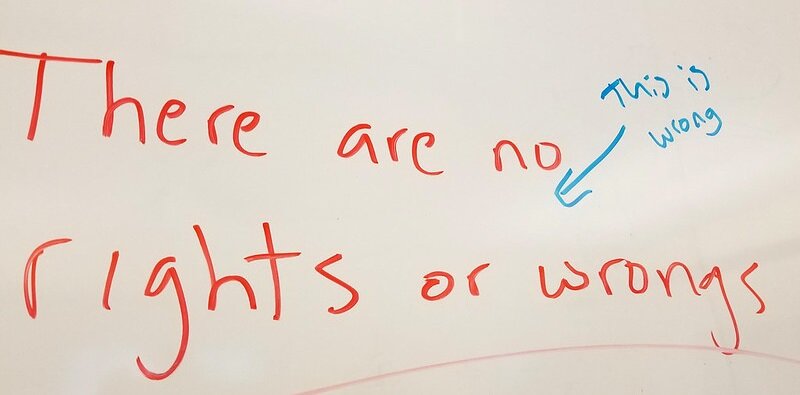
Getting it Right—Or Not

May 26, 2021 Pilgrim Congregational UCC
Rights and wrongs by quinn.anya licensed CC BY-SA 2.0.jpg

by Mindy Misener

Given that it’s been over two weeks since my second Covid-19 shot, I am now planning—if not participating in—events like maskless visits with friends, family vacations, even a dinner date in a well-ventilated space. I am thrilled by these new options and, truth be told, sometimes a little overwhelmed. I still have questions about what to do. Should I take my 10-month old on a plane? Ask friends about their vaccination status before having them in my house? What about being maskless with those too young to get a vaccine, or unable for some other reason?

Since the beginning of the pandemic, we have all been awash in both information and opinions. Putting aside conspiracy theories and egregious misinformation, it’s worth noting that even people who share a very basic set of facts can arrive at very different decisions. I would like to think the decisions I made over the last year were the right ones, but I can’t say that for sure. Maybe I should have relaxed my rules. Maybe I should have taken more precautions.

I hope that the days of making such choices will be over soon. That said, even if I’m not debating mask use in social settings next year, I’ll still have difficult decisions to make—decisions whose moral and ethical implications are unclear. The truth is, these kinds of questions hover over all of our lives. Should I go to college? Propose? Have children? Change jobs? Retire? Move? Try another round of chemo? 

Such decisions are not easy, but I can make them extra hard by pressuring myself—or allowing myself to give in to societal pressure—to get them “right.” When I feel myself cracking under this pressure, I try to remember a TED talk I saw a few years ago. In the talk, philosopher Ruth Chang challenges us to reconsider such decisions, not as right or wrong, but as a way to determine who we are. Framing life decisions this way helps me get away from the fear of a splashy X in divine red ink—Wrong! It also gives me the chance to step back and ask myself, “What do I even mean by a ‘right’ or ‘wrong’ decision?” On a knee-jerk level, I consider a “right” decision to be one that brings me a measure of pleasure, confidence, or peace. A “wrong” decision, on the other hand, leads to difficulty, regret, or pain. 

Once I can see the simplistic way I’m defining “right” and “wrong” decisions, I can start asking myself other questions: Isn’t difficulty instructive? Can’t regret shape my character? Haven’t some of the most painful things in my life been the most rewarding? What’s so terrible about being “wrong”?

Then, and only then, can I start getting creative with the decision-making process, seeing it as an opportunity for a kind of sacred play—whole-life play—rather than a test of whether I’m doing life right. Then, and only then, can I remember that God is not hovering over my days with a red pen in hand, but giving me an array of drawing tools and endless reams of paper on which I can make, and make, and make my life anew.

— Mindy Misener teaches creative writing at Montana State University
and serves as Pilgrim's 2021 stewardship chair

1 Comment

I Remember That Girl

May 19, 2021 Pilgrim Congregational UCC
Diary by benleto license CC BY-NC-SA 2.0.jpg

by Rev. Danielle Rogers

When I was a child I looked at the world with a wild curiosity, constantly asking questions and marveling at the change of seasons. I spent hours lying on blades of grass and picking up ladybugs, carefully counting the number of black dots before they flew away.

I blew on dandelions and ran through cold water sprinklers. I spent hours lost in a favorite book, devouring each word and imagining myself a kindred spirit with characters from the book Anne of Green Gables. I kept a diary well into my young adult life. I took time to write short stories, prayers, song lyrics, and poetry.

In every situation I was able to find space for my feelings, my overly ambitious goals, and my overabundance of questions. I had a question for everything? Why was the sky blue? Why do we have to sleep at all? Why do we live in the richest nation in the world, yet have such poverty in our country? As I grew into womanhood, the questions kept coming and the answers became more complicated.

When I entered my third decade of life I stopped writing in my journal. The myriad of books that gave me so much life were read less and less,  I stopped marveling at the beauty of nature around me, instead finding fault in weather that was too cold, or too hot. I began doubting my abilities, my talents, and the questions I had became more simplistic, the answers more pessimistic.

It didn't happen all at once, and for awhile I forgot I had lost her. The girl within who chased after  Ice Cream trucks during summer break, and spent hours on roller skates. The youth who talked on the phone with friends for hours, and created t-shirts to raise awareness about environmental pollution. The young woman who traveled hundreds of mile away to attend a college she couldn't afford to visit beforehand with nothing but a suitcase and a hundred dollars. The faithful girl who knew “God would provide a way out of no way,” with deep seated cemented faith. That girl, was she still with me, had I lost her? During the last year I have found that girl reawakening.

In a few days we’ll celebrate Pentecost: a time for us to celebrate the holy spirit entering into our lives as a flame that does not burn. I often imagine the Apostles marveling at the sight, perhaps scared, amazed, or looking up in wonder. What did the flame look like? Was it still like a tapered candlestick, or wild and billowy? What did it feel like? Did it stir up emotions of love or safety? Did it remind the Apostles of home, or being in their Mother's womb?

When I sit with these questions it pulls me closer to the text, and I recommit myself to follow in the teachings of Jesus Christ. I allow the joy of the feeling to spread into my thoughts and actions and how I see the world. 

In essence, I found that girl again. She was with me all along, waiting for a moment to show her face and remind me of  life's bigger picture. During this season I have found the gift of mindfulness. This is a gift we can all share when we take the time to revisit our past selves, when we encourage our imagination, and lie on grass and dandelions. When we do this, our very breath is a holy act and we can live our lives with a Holy Spirit of love and guidance.  I pray this seasons brings a reawakening in your faith journey, and in your life. May you find the Girl or Boy within and dare to dream, and ponder, and ask questions. Dare to live life with wonderment and faith.

— Rev. Danielle Rogers serves as Pilgrim’s Christian Education Director

1 Comment

Ascension-Pentecost

May 12, 2021 Pilgrim Congregational UCC
Whatever it is, the way you tell your story online can make all the difference.

by Tim Dolan

Ascension, celebrated this Thursday, May 13, draws our attention upwards, towards the clouds. How did the disciples arrive at the momentous event?

Firstly, Jesus came into their lives as a wise and loving teacher. Someone who when encountered could open one's heart and whose gaze conveyed the deepest knowingness and unconditional love and acceptance. Eventually the most wonderful Being came to face death in his own timing until his earthly body fell silent and was lost to sight. Those who loved him experienced that loss in great sorrow.

Then the light of Easter dawned and they were able to perceive him and receive a new, more profound teaching and communion with him. They wished this to go on and on, but finally the day came when it was necessary for them (and eventually for all humanity) to let go of this quasi-physical presence and to have their attention lifted up to the clouds:  the realm between the solid, gravity-bound earth and the cosmic expansion of the universe. This middle realm, permeated with the fire of the sun and the life-giving moisture that combine to draw forth the flowers of spring and summer, would be the last place they would see him in an outward way. These lovers, who had endured the horrific loss of the events of Golgotha and the exhilaration of Easter, now gazed into an empty sky instead of an empty tomb. Their bewilderment was not total since they had lived through the previous experiences and further teachings that left them in a somber mood, but now with an expectancy of what was to come from the future, from the unknown.

The culmination came on Pentecost, or what became known as Whitsun. Instead of being outer directed, this striking event emerged from within their very being. Each individual lover of Christ felt that they had somehow merged with the essence of the Christ spirit the fire of their individual spirits lit up within them, which was perceptible each in the other. Next, these spirit-permeated lovers of Christ encountered people arriving from all over, but it wasn't their foreignness that they saw. It was their common humanity and their common divinity that they saw.

A profound empathy and understanding came about, which shows us what is possible for humanity and a whole: A worldwide bond of all peoples no longer separated by nationalities, races, ethnicities or gender. No longer us and them, winners and losers, but a new cosmopolitan age wants to dawn in which we see and appreciate all that we have in common with every other human, extending to a love for the animal and plant kingdoms who surround us.

With our feet firmly planted on mother earth let our spirits join with all life, opening our gaze, opening our hearts to all that comes to meet us from the clouds, the clear blue sky, the sun, the stars, the planets and know that we are at home in the universe!

2 Comments

Toto, I've a feeling we're not in Kansas anymore

May 5, 2021 Pilgrim Congregational UCC
White out by nosha iscense CC BY-SA 2.0.jpg

by Kerry Williams

We all have our landing in Oz moments, don’t we? The starkest one I can remember was my first spring here in Bozeman. I made it through the winter, adjusting to the weeks of far below zero temperatures and learning to drive on the unplowed roads in my neighborhood. I came here from New England, so winter didn’t hold many surprises for me. Sure, there was more snow and cold, but there was also more sun, so it all balanced out, and I love winter sports so being right in the middle of all this skiing was great. I was dancing right through the seasons with a smile on my face.

So, when mid-April rolled around and the days got longer, I started planning a May Day barbecue. We had green grass, sunshine...  what more could you ask for? I ran the idea by Spencer, my Montana-born and -raised husband, who asked, “Do you mean Memorial Day, like at the end of the month?” Of course I didn’t. I meant May Day, on the first of the month. “You want to plan a barbecue OUTSIDE?” Yes, that’s where one typically holds them. “Ooooookay, go right ahead and plan that,” he said, as I wondered why he wasn’t totally on board with this fun idea.

On May 1, we woke up to 18 inches of snow on the ground. I had to cancel my May Day cookout. It was all very amusing, but I won’t lie, it was extremely disorienting, too. To believe the world works one way and then to find it doesn’t necessarily function the way you think it does is quite a shock. From then on, the word “spring” became a relative term, one that was constantly open to interpretation, instead of being the fixed concept I had always assumed it was.

I think we’re all in for a bit of my May Day Oz experience as the structures we’ve been living under for the past year fall away. It won’t be a clear-cut “that was then, this is now” situation, but rather a bit of Montana springtime “now you see it, now you don’t.” And just like Montana spring, we don’t always know how those around us are interpreting our shared experience. Is this person in front of me someone who has been slogging through the cold since January 1, just barely making it to warmer weather? Or is this person someone who continues to hike higher and higher into the mountains to grab the last shreds of powder under their skis well into June? Will today be a day where I bundle up in my down jacket and then watch my neighbor step out of their house in shorts and a T-shirt? Yes to all of that.

So, just like every spring, let’s give each other room to emerge into the world again. Let’s enjoy the fact that we finally get to see our friends and neighbors after so long, even if there’s some space between us. And let’s appreciate that we will all be feeling disoriented and unsure of what we should be doing. It feels like Faith, Hope, and Love are calling in a more poignant way than most of us have experienced in a long time, and as they say: “The greatest of these is Love.” That’s what is leading me as I venture out into the world these days, where decisions about personal interactions are anything but clear-cut. Along with, of course, the old classic: “Never plan a May Day barbecue in Montana.” 

— Kerry Williams serves as Vice Moderator for Pilgrim Church

Comment

The YOLO Phenomenon

April 28, 2021 Pilgrim Congregational UCC
Space Escape Grunge Sign by Free Grunge Textures license CC BY 2.0.jpg

by Rev. Dick Weaver

My wife, Cathy Barker, is “eruditer” than I am, and has an online subscription to the New York Times. She shared with me an article by Kevin Roose dated April 21, titled, “Welcome to the YOLO Economy.”

It’s an article about how some younger working people, who for one reason or another have some investment income or money in the bank, are either leaving what have become stultifying jobs or are contemplating doing so. The reason is “YOLO.” You Only Live Once. The writer cites a recent Microsoft survey that says more than 40% of workers, globally, were considering leaving their jobs this year. Another social network found that 49% of its users actually planned to get a new job this year.

Now, I don’t actually know how different those statistics are from any normal year’s data. But the article talks about how the pandemic has affected younger workers. Many, of course, have lost their jobs. But others have found that they like working from home and don’t want to go back to the office. Others are feeling the need to simply give up the “just a job” kind of work to explore things more in line with their passions. YOLO. “We’ve all had a year to evaluate if the life we’re living is the one we want to be living,” said Christian Wallace, a senior lecturer at Harvard Business School, who was quoted in the article. Languishing at home, even while still “at work,” has given people the opportunity and the encouragement to do some soul-searching. And they’re contemplating or actually putting into action such things as moving to the Caribbean to start a tourism company, or giving up a big salary accompanied by big pressure and small job-satisfaction in order to do something similar but in a smaller firm or by working for themselves. Or moving to Montana!

I was a child in the ‘50s, so I may have no clue what was really going on, but things seemed fairly stable then. You finished school or got out of the military, then you got a stable job and bought a small house, and life went on. Were people happy and fulfilled in their work? I doubt it. But the desire to fit in, settle down, and find job security actually did bring some satisfaction with it. Now? I don’t know.

People move to Montana partly to get away from lackluster careers, locations, or visions for the future. We’ve certainly found out during this pandemic year that people with a good deal of money are moving to Montana! I can’t blame them. Are they finding what they want here, where you don’t have to drive very far to get to the nearest trout stream or trailhead? I hope they are.

I’m wondering what personal faith has to do with this YOLO phenomenon. Back in the good-old-days, people at least claimed, for example, to belong to religious or faith organizations. Today, there are many people in their 50s and younger who have maybe never set foot inside a church, synagogue, or mosque. Not that church membership really means that I’ve actually got a spiritual life. But it’s a start. I think that people have realized, though, that personal satisfaction doesn’t come from a fat paycheck in a dead-end job. Riding on a commuter train an hour-and-a-half each way to squeeze into that same job certainly doesn’t work for people in the same way it used to work. If being part of a faith community isn’t part of the equation, I hope the trout stream is. In any case, I think a sense of lack or inadequacy in one’s personal spirituality is part of the equation, even if individual seekers don’t know it. Are these folks exploring that, or just quitting their old jobs in some undefinable quest for nirvana?

Is this YOLO-driven trend of dissatisfied time-clock-punchers really going to reshape not just how America works but how we actually live? Is there a place in this incipient new world for people of faith and for our faith communities? How can we, who are maybe already “livin’ the dream” here in Montana, have an impact in whatever new economy is taking shape? (I’m defining “economy” here to mean something like the management of a system, or the entire management of a household or state: “oikonomia.” Note that the word “ecology” has to do with the relationship between organisms and their environment—not wildly different than the broader understanding of “economy.”)

I hope we are indeed seeing the reshaping of our economy into something that’s more life-giving. Maybe faith communities such as Pilgrim have a place in the new world that is forming around us. Shall we find out?

— Rev. Dick Weaver currently serves as Supply Pastor for Pilgrim Church

Comment

Dreams—even nightmares—offer guidance and healing

April 21, 2021 Pilgrim Congregational UCC
Relax. Everything in the dream is You by Cate Storymoon license CC BY-SA 2.0.jpg

by Connie Myslik-McFadden

The Bible has many references to dreams and the profound effect they had on people and history. Today, many people pay attention to their dreams because they have found that doing so helps them to become more conscious, more whole, and more able to be compassionate, loving human beings.

Robert Moss is one of my favorite dream teachers. He is a shamanic dreamwork explorer, teacher, writer, and worldwide workshop leader. Though I've had a lot of Jungian dreamwork training and have been working with dreams for many years in my psychotherapy practice, I enjoyed learning and practicing Robert's techniques in his Dream Teacher Training. Dream re-entry, Dream Theatre, Shamanic Journeying to find power animals and guides, and Creative Expression are among the tools he uses to help people heal through dreamwork. Drumming is integral to his work, as its steady rhythm enables dreamers to relax and open up to their imagination and to other realms. This is a different experience from dream analysis and can richly enhance the more traditional ways of exploring dreams.

One of the basic tools Robert teaches is the Lightning Dreamwork Process. It is quick and effective! Because I have been a psychotherapist, in my practice I expand the process to include more of the dreamer's history, current life situation, etc. But anyone can benefit from the Lightning Dreamwork Process. It is worth knowing. Here are the steps to follow, assuming you are the listener:

Ask the dreamer to:

  • Tell the dream, as if it is happening in the present.

  • Give the dream a title. This will bring more focus to what follows.

  • Tell you how he/she felt when she woke from the dream. This is crucial to understanding.

Then ask:

  • "What in your real life—past, present, or possibly future—might correspond to the images in the dream?" Give the dreamer time to think about this. Then ask questions about the images in the dream, e.g., if there's a bear encounter in the dream, "How do you feel about bears in general?" "Have you read or seen anything about bear encounters in the past few days?"

  • "What do you want to know about this dream?"

Then say (because you have been picking up clues from what the dreamer has told you):

  • "If it were my dream, I'd wonder about..." and say what it is you're curious about, i.e., "I'd wonder if this bear came to tell me something I need to know", or, "I wonder if there's a bear part of me that I'm unaware of and need to make more conscious." This helps the dreamer expand his/her perspective on the dream and go more deeply into the possible meaning of the dream. Remember also that because dreams can be both literal and symbolic, the dream can have more than one meaning.

Then say:

  • "What would you like to do with this dream?" There are several possibilities. The dreamer could re-enter the dream to dialogue with the bear; re-enter the dream and let his/her imagination go beyond the ending of the dream to see what happens next; sketch the dream; write dream poetry; make a bumper sticker based on an "Aha" about the dream's meaning; or do dream theatre with a friend or friends.

Working with dreams in this way is rich, powerful, and healing.

— Connie Myslik-McFadden has been a Jungian-oriented psychotherapist
and writer for many years, and is a member of Pilgrim.

1 Comment

Deus ibi est.

April 14, 2021 Pilgrim Congregational UCC
4-14-21 post Pilgrim collage.jpg

by Wendy Morical

As our beautiful valley enters fully into springtime, I’ve been delighted by daily reminders of burgeoning life. The sandhill cranes are back in our field, and catkins droop from our aspen trees. For me, one of the most beautiful, hope-filled sights in recent days was the live Easter service shared by a small number of Pilgrims and broadcast to the rest of us. It was uplifting to see life return to the sanctuary, recognize voices speaking of their joys, and hear the Easter news straight from Reverend Weaver’s mouth. Hallelujah!

One of the best moments of the service was when, for the first time, the call to prayer that Reverend Weaver has introduced to us online was lifted up by voices around the room, softly and with gentle harmonization. (It’s at about 40 minutes on the recording if you haven’t listened to the service yet). We began by hearing Dick’s familiar voice in solo, just as he has been singing this meditative call from his home for weeks. Soon, however, other voices joined in, growing in confidence, and branching out into gentle harmonies: Ubi caritas, et amor. Ubi caritas, Deus ibi est. Where there is charity and love, where there is charity, there is God.

It was profoundly moving. This moment seemed emblematic of what’s ahead as we come together – each from our separate place of worship, prayer, contemplation, and meditation – to resume our Christian fellowship.

But will we simply resume? I have been thinking a lot about our church and what is ahead for us. Obviously, we will be thrilled to be able to meet in person and rekindle the energy of our building: hearing children giggling in the hallway, browsing the books for sale, enjoying gifted musicians in a shared space. A church is not the physical space, though. For all our dismay and longing to be back in our building, that structure on South Third is not Pilgrim Church. Throughout the Bible, when the word church is used, it designates the people (ekklēsia), not a building. Biblically speaking, people do not go to church, people are the church.

It’s us, the people who have chosen to gather there in covenant with one another. We are not a holy enclave of like-minded people who all believe, think and experience things in the same manner; in fact, we have significant differences. Nonetheless, we have willingly unified in a committed community of people who are striving, individually and together, to hear God’s voice and respond through lives of faith. The longing we feel for one another is certainly based in our genuine enjoyment of one another, but it’s also a craving for that human space in which we can be vulnerable, uncertain, and searching but also find ourselves accepted and supported. We trust in the charity with which we will be met by others in our Pilgrim family.

In imagining the months ahead, take a moment and dream of what the 'coming together’ of Pilgrims could be for you. How can our fellowship best challenge and sustain you in your life of faith? How might we, together, be a greater, more loving presence in Bozeman and beyond? I’d like to invite you to prayerfully open your hearts to even deeper ways for us to follow Jesus, loving and supporting one another as well as those in our greater community. As a church, we will be reflecting, sharing, building, and celebrating Pilgrim in the years to come. This work will take all of us, but we won’t be working alone.

Wherever we gather with charity and love, God will be with us.

3 Comments

Regular Easter People

April 7, 2021 Pilgrim Congregational UCC
Raised to the Resurrection of Life by Lawrence is license CC BY-NC-ND 2.0.jpg

by Mindy Misener

To say I was excited to go to church on Easter would be an understatement. By eight in the morning I’d laid out clothes for both me and my daughter (my husband was spared my outfit services). Typically, we're part of the crowd that slips in moments before—or, gulp, after—the opening bell, but this time we actually got ready early enough that we had time to take family photos before we headed to the church. Despite masks and the altered seating arrangement, the whole service felt startlingly—and delightfully—familiar.

How fitting that Easter would be the first day in over a year that Pilgrim offered an in-person service. How fitting to be able to spend the day meditating on hope and renewal. Even the weather obliged, with its unseasonable warmth and bright sun.

Yet all last week, as I anticipated Sunday’s service, and afterward as I went home, my thoughts strayed from the traditional themes of hope and renewal and landed, over and over again, on the role of the witness. After all, the Easter story is not only a story of resurrection. It’s also a story of regular people who went looking for the one they loved. Of regular people who did not find him where they expected him to be. Of regular people who went around for days, then weeks, murmuring in corners, and huddling at the sides of roads. Can you believe it? But how? What does this mean?

The Easter story as we know it depends on these regular people and on their shared bewilderment. The resurrection could have gone any way God wanted it to. It could have been a quiet, low-key thing, like a black-tie dinner with light piano tinkling in the background. Or it could have come with all the glitz and noise of a Super Bowl halftime. But instead, the resurrection rollout was a chaotic affair. Actually, from a marketing perspective, it was kind of a disaster. Few knew what was going on. Fewer still believed what they heard, at first.

It’s absurd, isn’t it, that God would leave those regular people, with all their hang-ups and confusions and conflicted feelings, to each other? That God would entrust those regular people with the mystery of the cross, and the meaning of resurrection?

I believe that the story of the resurrection is not a puzzle that was solved all those centuries ago. Rather, it’s an ongoing mystery, one we bear both individually and in community. The mystery of the resurrection calls on us to continue witnessing—not so we can convince others to confess x, y, and z, but so that we can learn from the humbling bewilderment of the cross and the empty grave. So we can gather and ask, Can you believe it? But how? What does this mean?

— Mindy Misener teaches creative writing at Montana State University
and serves as Pilgrim's 2021 stewardship chair

2 Comments

Breathe 2, 3, 4

March 31, 2021 Pilgrim Congregational UCC
Meditation by  T Man license CC BY-NC-ND 2.0.jpg

by Rev. Danielle Rogers

During the last two months I have entered into the practice of mindful meditation. Everyday I sit on my mat and breathe deeply from my diaphragm filling my lungs with air before slowly exhaling. After a few minutes I can feel my body responding to the rhythmic inhalations and exhalations of my breath, all to the measure of four counts. It's deeply healing not only for the mind but for the body.

I live with two very painful chronic neurological pain conditions that affect my central nervous system. These conditions are made worse with stress and through much research I found a multitude of studies on the benefits of mindfulness and meditation.

I live in a world bombarded with a myriad of information. Constant over stimulation from social media, work, community service, and family obligations have left little time to focus on my spirit, or on my breath. Slowing the mind creates a chain reaction that helps me focus on my pain in a neutral way, without adding negative connotations of my own worth.

As we enter into Holy week and prepare for Jesus' betrayal Jesus' betrayal by his disciple, his crucifixion and resurrection, I will include the act of mindfulness in my daily prayers. I will allow the spirit to lead me to scriptures that will help me recognize the ultimate gift Jesus gave to the world. I will follow his journey each day and see him live this human act of love. The amount of grace he gave all of us through his ministry and his life is beyond humbling.

To sit and be alone with your own thoughts in prayer is a holy act. It can be done everywhere and this week I will engage in the present moment only. As I take a breath and breathe in the lessons from the scriptures of the Gospels, I will be mindful to involve each day of this week with true curiosity and wonder. From the triumphant entry on Palm Sunday, to the clearing of the temple on Tuesday, leading to Jesus going to the Mount of Olives, to wondering what Jesus may have done on that Wednesday perhaps anticipating Passover, to Jesus' humble act of foot washing, followed by his arrest sealed by Judas' kiss, his trail, leading to his death through crucifixion on Good Friday, his preparation for burial, and finally his rebirth and resurrection on Easter Sunday.

Each day I will allow myself to focus on each event, and only that event. I will try to walk that journey with Christ.

I pray you all have time this week for mindfulness in this season, to allow your spirit time to progress away from the busyness of our lives. Take a moment and feel yourself engulfed in the mystery of spirit and as you do, breathe deeply.

— Rev. Danielle Rogers serves as Pilgrim’s Christian Education Director

2 Comments

The Kingdom of God

March 24, 2021 Pilgrim Congregational UCC
tiny fire by michael pollak license CC BY 2.0.jpg

by Tim Dolan

In the Synoptic Gospels, Jesus refers to the Kingdom of God (or, less frequently, Heaven) on more than 50 occasions. I won't try to be definitive in this blog post, but at least to give food for thought and characterize it in a meaningful way.

In the first century, under the brutal Roman occupation, the Jews were obsessed with apocalypticism, a widespread fervor and belief that divine forces would intervene to end history. It was popular because it meant that people who had followed God honestly and in spirit could hope to be vindicated and taken up to heaven (the wicked would finally get justice).

Jesus was well aware of that fervor, but his teaching was confusing to those close to him. In terms of the righteousness that many thought would come down from the heavens he said it would not be coming down so stop craning your necks to the sky: that other country was already here! We are familiar with the dramatic assertion in Luke 17:21: “the kingdom of God is within you” and less known Luke 11:20, “the kingdom of God has come to you.” Lastly, in the Gospel of Thomas: “I have cast fire upon the world, and look, I'm guarding it until it blazes” (Thomas 10). Jesus isn't referring to a future time when he will cast the fire of his Father's kingdom down here. It's already ignited.

So I invite you to take a moment today to sit without distractions and open to the question, “If the kingdom of god is present within me and the world, how is it showing itself?”

The promise is of an experience of the divine life that is a direct participation. For this we might well shift our attention from abstract thoughts to a thinking centered in our hearts. The fire you sense may be a small flame for now. We can place our hands around it for warmth and also to protect it. Maybe we have some dried grass to add and gently blow to ignite and add to it's presence in our lives and the lives of others.

— Tim Dolan is chair of Pilgrim’s Spiritual Life Committee

1 Comment

Grappling with Luck

March 17, 2021 Pilgrim Congregational UCC
A Little Luck by JD Hancock license CC BY 2.0.jpg

by Kerry Williams

It’s March 17, which means it’s Saint Patrick’s Day. And, for a kid like me who grew up near Boston, that’s a holiday you make sure to celebrate!

In my town you were either Irish Catholic, Italian Catholic, or something else. I was in the something else category, coming from German Lutheran stock on both sides. I once had a girl from high school ask why I worshipped the Rev. Martin Luther King, Jr. So that’s an indicator of how out of the norm my family was.

Anyway, being surrounded by Irish culture and tradition meant that there was always talk of luck this time of year. In my family, however, there was no such thing as luck. “There are no coincidences!” my mother used to say. She believed in fate. The way she understood destiny came across as passive, in the sense that whatever is meant to be will be. So when something good happened, it was not lucky, but the universe turning in its own unfathomable way.

Then I met my future husband in college, and was shocked at how offended he was at this way of seeing the world. He also thought there was no such thing as luck, but for him that’s because everything that you produce in life is a result of your hard work and determined effort. He believes that life is to be taken by the horns and decisions made actively. The worst thing you can do is wait to see what might happen because then you’re throwing away your power to choose. He is firmly in the camp of “You make your own luck!”

It took me years to balance these opposing beliefs and find the place where I am comfortable, which is pretty much smack dab in the middle. What does that look like? It means I wrestle with decisions actively, but hold off until I get the feeling that it’s “right” somehow. I don’t necessarily recommend this – it’s exhausting! – but it’s the only way I can forge ahead in life, so that’s what I’ve settled on.

I thought I had found the Third Way in the luck debate, but lo and behold, as my relationship with my husband’s family deepened living here in Montana with them, I was exposed to an entirely different concept of luck, and that was “being blessed.” Again, I encountered people who don’t believe in luck, but for them it’s because any good thing that happens is God rewarding faithful behavior. I was always under the impression that being blessed was more in line with grace, as if God sprinkles his gifts around randomly and if one happens to land on you then be thankful! It took me a long time to understand that being blessed for some people is an accomplishment that they feel they have done something to deserve.

So where does that leave me? For one thing, grappling with luck on a daily basis. I am thankful that having kids introduced me to the children’s book Zen Shorts. In the book, Stillwater the panda tells stories that demonstrate Zen concepts, and the one that sticks with me most is about a farmer whose horse runs away and his neighbors say “such bad luck!” When the horse returns with two other horses, the neighbors say “such good luck!” When the farmer’s son gets thrown from one of the wild horses and breaks his leg, the neighbors again say “such bad luck!” but when the military comes to take young men off to war and pass him by, they flip back to “such good luck!” The farmer’s response each time as to whether his luck is good or bad is simply “maybe.”

So maybe I believe in luck and maybe I don’t. What I appreciate is that each person sees the world through their own lens, and I guess the degree to which you put on shamrock colored glasses is just one piece of that puzzle. Just know that I wish you good luck on the path ahead of you, whatever that means!

— Kerry Williams serves as Vice Moderator for Pilgrim Church

2 Comments
← Newer Posts Older Posts →

Powered by Squarespace. All contents of this site are copyrighted by their respective owners.