
• Landing
    • Online Services
    • Mission
    • Watch online
    • In-Person Services
    • Welcome
    • What We Believe
    • Mission Statement
    • In Pictures
    • Our History
    • Meet Our Staff
  • Giving
    • Contact us
    • Get Our Newsletter
    • Job Opportunities
    • Blog
    • Music
    • Christian Education
    • Adult Education
    • Women of Pilgrim
    • Social Justice
    • Called To Care
    • Events List
    • Calendar
    • Upcoming
    • Sign up for activities or volunteering
  • Facility Use
  • Search
Menu

Pilgrim Congregational UCC Bozeman

2118 South 3rd Avenue
Bozeman, MT, 59715
406·587·3690
Seek. Grow. Serve.

Your Custom Text Here

Pilgrim Congregational UCC Bozeman

  • Landing
  • Services
    • Online Services
    • Mission
    • Watch online
    • In-Person Services
  • About
    • Welcome
    • What We Believe
    • Mission Statement
    • In Pictures
    • Our History
    • Meet Our Staff
  • Giving
  • Contact
    • Contact us
    • Get Our Newsletter
    • Job Opportunities
  • Ministries
    • Blog
    • Music
    • Christian Education
    • Adult Education
    • Women of Pilgrim
    • Social Justice
    • Called To Care
  • Events
    • Events List
    • Calendar
    • Upcoming
    • Sign up for activities or volunteering
  • Facility Use
  • Search

Pilgrim Blog

Pilgrim UCC Bozeman Blog

What have you lost? What have you gained? What have you learned?

March 10, 2021 Pilgrim Congregational UCC
3 questions.jpg

by Rev. Dick Weaver

My spouse, Reverend Cathy Barker (she prefers that I just call her “Cathy”!) occasionally takes part in “Dances of Universal Peace” events. Nowadays, these events take place online, as do many such things. The three questions above came from a discussion that was held recently at an online dance, though she says they aren’t copyrighted or patented, and so anyone might have created them; anyone can use them.

We’re all dealing with the whirling uncertainties and new developments of living with the Covid-19 pandemic and the changes in our lives and fortunes that have come along because of that, or because of other things that shape our existence. But it’s good to stop once in a while to evaluate. Sure, we’re still wearing masks and being more careful than we might have been otherwise; and sure, we don’t know if or when we’ll return to something that feels “normal.” It’s still good to step back just a tad and see how we might answer questions like those. As people of faith, we might add to the list of three with one or two more:

“As a person of faith, do you see God’s presence or activity during this time? How?”

“How has this period of your life challenged your faith?”

There are all sorts of spin-offs from these additional questions, too. Feel free to follow them where they might take you.

What have you lost?

Have you lost friends or loved ones? Have you lost friendships, or have relationships changed in painful or in helpful ways? Do you miss the daily interactions at work and when you’re out and about? Have you lost your job? Your home? Your savings? Have you lost whatever sense of security you had previously? Have you lost faith in God, or has your faith changed in challenging ways? Finally (or not so finally) What losses can you let go of without too much difficulty?

What have you gained?

New appreciation for friends or family? Knowledge that you LIKE or DISLIKE working from home? A better relationship with your spouse/partner? The chance to do things at home that you might have kept putting off? A new, closer relationship with God or the Universe? Clarity? What gains do you want to retain when things get back to “normal”?

What have you learned?

How to play the bagpipes? A new language? That your spouse or partner really doesn’t like something you love? More about how to get along with people you are close to? More about what makes you tick? More about Love? A new worldview? What do you want to keep on learning?

“As a person of faith, do you see God’s presence or activity in the midst of a pandemic?”

If so, what does God “look like” now that seems different than before? What are the implications or messages for your life?

If not, what’s different? Where has God gone off to? How do you feel about this?

“How has this period of your life challenged your faith?”

You answer this one!

Friends, the Show isn’t over! We are still here, and I believe we’re called to cherish our loved ones more than ever, and to expand the list of who qualifies. May God bless you as we grow in love and light.

— Rev. Dick Weaver currently serves as Supply Pastor for Pilgrim Church

Comment

An excerpt from 'The Second Bucket List'

March 3, 2021 Pilgrim Congregational UCC
bucketList450.jpg

by Connie Myslik-McFadden 

In The Second Bucket List, Celeste has begun seeing a therapist, Sonia, to help her deal with her terminal diagnosis. The following excerpt is taken from one of their early sessions:

       Sonia paused and took another sip of her tea. Celeste had left her coffee mug in the car, and now she wished she had brought it in.
“If you’re open to it, I can help you explore your beliefs and attitudes toward life and death. You might come to accept that death is a normal part of life, and paradoxically, that there is actually no such thing as death. Nothing really dies, it just changes form.”
Sonia paused again, and Celeste was aware she was searching her face for a reaction. Celeste took her time, wondering if she wanted to think about death at all. Maybe it would be better to just enjoy life for as long as she could.
But here I am, and I may as well make the most of it.
“What do you mean, no such thing as death?” she finally asked.
“I realize it’s a radical concept. But I’ve come to believe it’s true.”
“I don’t know if it’s possible for me to understand death that way.”
Sonia nodded. “I can explain some concepts and you can choose what and what not to accept. You’re already pretty conscious; you’re not starting from scratch. If you’re willing to record your dreams and keep a journal, you may experience a lot of spiritual growth during this time. All I ask is that you be as honest as you can be, and that you trust the process.”
Celeste nodded again, not wanting to speak her doubts. “I do trust the process,” she said after another quiet moment. “And I like what you said, I like the hopefulness of continuing to evolve even while ALS is getting worse. What I don’t trust is the disease. The only thing that’s certain is that it’s going to kill me. I don’t know how long it will take, what that’s going to be like. I don’t know if I’ll have the time or energy to do what you’re suggesting. The neurologist said my mind will be good right to the end, but my body . . . “
She couldn’t finish the sentence, couldn’t find the words to explain how betrayed she felt by her body. She yanked a tissue from the box on the side table and wiped her eyes.
“It’s really depressing.”
Sonia nodded. “Of course it is,” she said gently.
“I’d rather listen to you right now than talk. Would that be OK?”
“Sure,” Sonia said. “So . . . one thing to consider is that we are all spiritual beings on a human path. When we are born, we are given all the circumstances we need to learn the lessons we need to learn. We don’t know that as children; it takes years to reach conscious understanding of why we were born into a particular family, why we have the challenges that we have. What our karmic issues are.”
She paused, watching Celeste. “Often we get trapped by our lower self qualities, meaning pride and self will and fear, and unconsciously we create a hellish life here on earth. We turn our backs on our essentially spiritual nature. Ideally, we do everything we can to learn our lessons and align ourselves with the Divine as we understand it. If we do, we can live more creative, fulfilling, and peaceful lives. Most people don’t do it, because it’s hard work.”
Sonia paused again. Celeste was listening intently.
“Each time we incarnate again as physical beings, we have a chance to live more from our higher Self. Our God Self.  Each time we die, our souls return to the world of spirit. There we are given the opportunity to review our life with compassionate guides -- angels -- to see where we have made good choices and where we have fallen short. We continue to learn in the world of spirit, and eventually we incarnate again. This cycle is repeated many times until we no longer need to be in physical form.”
“It sounds Buddhist.”
“Many of these ideas are in accord with Buddhism and other religions.”
“Do we have to believe in God for this to happen?”
“No. It’s not really about belief, it’s more about evolving consciousness, resulting in deep knowing.”
Celeste shifted in her chair. A wave of fatigue swept over her.

— Connie Myslik-McFadden has been a Jungian-oriented psychotherapist and writer for many years, and is a member of Pilgrim. Her novel The Second Bucket List is a poignant and uplifting story about the emotional and spiritual journey of a forty-nine year old woman who is diagnosed with ALS.

Pilgrim Blog RSS

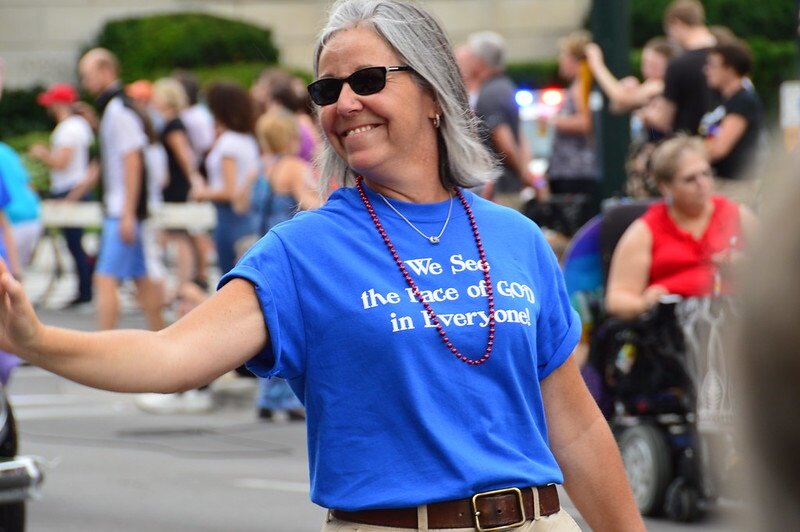
The Face of God

February 24, 2021 Pilgrim Congregational UCC
Face of GOD by appaIoosa license CC BY-NC-ND 2.0.jpg

by Wendy Morical 

Rev. Danielle Rogers recently asked us to consider living our faith “publicly and unapologetically,” to flex our faith and act on it boldly. In Danielle's post, she wrote of our Christian faith serving as a “moral compass” guiding us to behave in ways that align with the teachings of Jesus.

In his book Love is the Way, Bishop Michael Curry uses a similar analogy, calling love “God’s GPS.” According to Curry, “Love tells you how to direct the energy of outrageous faith.”

This past week, the Bozeman community lost a beloved school principal, Craig Kitto. According to those close to him, Mr. Kitto was a man of deep faith. Of course, working in a public school didn’t allow him to speak directly about the central role Christian teachings played in his life, but he acted that faith daily, boldly, unapologetically. Teachers at Whittier School report how he met the busses every day with smiles, kind words, and hugs for the students. He told misbehaving children, after discussing their behavior infractions, that he loved them and believed in them. The whole school bore witness to his outrageous acts of Christian love.

As a teacher, I was gifted with a new batch of students every year. Every child entrusted to my care was valuable to me and, as the year went on, I genuinely grew to love each one. Year after year. Friends would challenge my assertion that I cared deeply for all of my students, pointing out – rightly! – that some kids behave like jerks. Those were the students who found their way most deeply into my heart, however, because they were the ones who required the most of me: my time, thought and care.

The sanctity of my work came to me slowly, as I noticed the endless capacity for care in other members of my profession and as I connected the dots between the work I did and the faith I professed. In a Chronicle article Lana Kitto said about her husband, “He had no judgment. Craig just saw the kid, the soul.” I have worked with many, many individuals who shared that perspective. We didn’t talk about our church membership or our personal righteousness, but we looked for and saw the face of God in every child. We tried not to impose our judgment on individuals, but instead trusted that they were valued and loved members of the human family, imbued with the divine spirit of God.

Some might say it is unique to the domain of working with children that we see them as people who are as yet unspoiled and therefore easier to love. In response, I would have to wonder: At what point do they imagine God that would give up on a person and extract the divine human essence, the soul that Mr. Kitto found in every student? I’d like us to consider that this view of our fellow humans can be cultivated and practiced, in an effort to truly see all of those with whom we share this life. If we set out into the bigger world with our Christian moral compass, using the GPS of God’s love, we confirm the miraculous reality: God is in every person.

During the pandemic, we have all come to recognize the necessity of human contact, even that of the most basic sort. Many encounters may be tinged with stress or anxiety due to our private concerns, yet a kind and receptive outlook — honoring the holy in the server, cashier, receptionist, or neighbor — begets kindness and offers another the joy of being seen. This practice serves us by creating a feedback loop of affirming and being affirmed; of praising God and receiving God.

I am from Wisconsin and grew up taking winter seriously. One of my pet peeves is unshoveled sidewalks, especially ones that I have to maneuver during my weekly trudge to the MSU campus where I now work. Walking back to my car recently, I approached a young man applying himself vigorously to the task of clearing his sidewalk on South 10th. Even though he was a full-grown person, I lapsed into teacher talk: “You’re awesome! Thank you for shoveling your walk.” He raised his head from the task and gave me a beatific smile. I was suffused with joy. 

Reflecting back to the image of flexing our faith that Danielle shared with us, I share these words of Bishop Curry:

The way of love will show us the right thing to do, every single time. It is moral and spiritual grounding – and a place of rest—amid the chaos that is often part of life. It’s how we stay decent in indecent times. Loving is not always easy, but like with muscles, we get stronger both with repetition and as the burden gets heavier. And it works.

— Wendy Morical serves as Moderator for Pilgrim Church

Pilgrim Blog RSS
1 Comment

The Outage

February 17, 2021 Pilgrim Congregational UCC
469099723_541fafa5a5_c.jpg

by Mindy Misener

Last week, as I was scraping the last bites of dinner out of my bowl and trying to have a real conversation with my spouse over the yodels of our seven-month-old, the power went out.

The first thing that struck me—other than the darkness—was the silence. Our wood stove’s blower shut off. The electric whine of the radiators stopped. The small buzz of the humidifier, the subtle hum of the water heater, and every other high-pitched, ambient white noise disappeared, revealing the quiet we’d been clogging up with our machinery. The fire flickered behind the tempered glass of the wood stove’s door, casting a very faint orange light across our living room.

It was almost peaceful, except, of course, it wasn’t. Outside, the temperature was negative eleven Fahrenheit and falling. Our wood stove can provide ample heat for one room if the fan is on. But the fan relies on electricity. So does heat for the rest of our house. Also, we don’t own a generator.

As anyone else who was affected by the outage Thursday night already knows, the power was restored after about forty-five minutes. And I should be clear that, given advantages like a working car and the ability to pay for a night or two in a hotel if need be, I knew we were not in any grave and immediate danger. Even so, I was struck by a feeling of vulnerability. The night, with its deep deep cold, suddenly seemed vast and uncaring. And I was small, and only human.

*

I agree with the Buddhist teacher and writer Pema Chödrön who said, in so many words, that as we move through our adulthood we become, on the whole, either more vulnerable or more fortified, more open or more defended, more soft in our ways or more hard.

Powerful knee-jerk defenses and rigidity of thought give us things to do: make a plan, be stern and uncompromising, stick to our guns. Vulnerability, openness, and emotional flexibility, on the other hand, give us, first, much to feel. We have to allow our discomfort, our fear, our weakness. We have to come to grips with all we don’t know.

*

That night, while my spouse researched the extent of the outage and contacted friends, I went through the motions of putting the baby down for sleep. I knew, intellectually, that there was at present nothing else for me to do. Even so, my mind kept flying off the handle—making a packing list, or wondering if a wood stove built into a wall would radiate enough heat to keep it above, say, forty degrees in the living room. Probably not. Would local hotels have power? On and on my mind churned, until I again stopped trying to fortify myself against a situation I still didn’t even understand.

It’s not fun to feel vulnerable. It certainly doesn’t fit into any standard categories of “self-help,” most of which are designed to make me feel more secure and stable. Maybe the most I can say for the experience is that it’s an honest encounter with who I am and who I’m not. What I can do, and what I can’t control. What I know, and what I can’t foresee. These value in these truths, as the saying goes, is that they set me free—to be a full, fallible human. To experience the whole sweep of what it means to be alive, in all its loveliness and all its questions and all its losses.

Had the power stayed off that night, there would indeed have been plans to make. We would have needed to be organized and clear in our direction. I’m glad the night didn’t come to that, for our sake and for the sake of our neighbors and friends. But I’m also grateful for the opportunity to reflect, again, on the tentativeness that defines my life and circumstances. May this reflection give me the compassion and clarity to see every life around me for what it is: a lived experience just as exquisite—and provisional—as my own.

— Mindy Misener teaches creative writing at Montana State University
and serves as Pilgrim's 2021 stewardship chair

1 Comment

It's Time to Flex Your Faith

February 10, 2021 Pilgrim Congregational UCC
Salto de Fe - Jump of faith by abel.maestro CC PDM 1.0.jpg

by Rev. Danielle Rogers

When I was a young woman I remember saying to my mom, “being a Christian requires work. It's not a passive faith.” She smiled and agreed saying, “ Yes it requires work. You should never feel too comfortable as a Christian.”

Her words stay with me today as I see so many conflicts and atrocities in our society. There was a time when I felt I could remain in quiet contemplation and inwardly practice the agape love Jesus teaches, but that time is long gone. Any complacency I may have had was replaced with an urgent call to speak against injustice, advocate for the poor and marginalized, and organize with others who have learned from the great theologians of Liberation Theology.

“You should never be too comfortable as a Christian.” I recently read a poem by Rev. Traci Blackmon that speaks to the great divide occurring within Christianity right now. Division within the faith is not a new concept. In fact there have always been disagreements about how the Faith is practiced.

Today I find myself aligning with my moral compass as taught by Jesus, and if it doesn't align, I must speak up loudly and with confidence. Rev. Blackmon's Poem reads:

I want to meet your god.
To see if your god really exists.
The god you preach about.
This god you quote and say you read about.
This god who cannot hear the children cry.
This god who does not provide shelter.
This god who is nourished but does not feed.
This god of guns but not of grace.
This god of Kings but not of kingdoms.
This god of greed but not of generosity.
This god of the womb but not of the woman.
This god who fears black skin.
This god of America but not all America.
Not all of the world.
I do not know your god.
What is your god's name?

— Rev. Traci Blackmon, Executive Minister, United Church of Christ Justice & Witness Ministries

We have an opportunity to live our faith publicly and unapologetically. We no longer can remain quiet and allow other interpretations to do harm in Jesus name. When we say nothing, it allows others to speak for all Christians. It's time to flex, to strengthen your faith muscle and proclaim the word according to your moral compass.

In Isaiah 58:6-10 we are told to worship actively and not to a dead and hollow God:

“Is not this the kind of fasting I have chosen: to loose the chains of injustice and untie the cords of the yoke to set the oppressed free and break every yoke? Is it not to share your food with the hungry and to provide the poor wanderer with shelter-when you see the naked, to clothe them, and not to turn from your own flesh and blood?”

I pray we as a congregation will continue to do our part, to strengthen our selves in the word of God and follow in Jesus' teachings that rely on our acts, not just our prayers, not just our good intentions, but requires us to be uncomfortable. Relish in that feeling and grow from it. It's time to flex your faith and show the world another interpretation of a loving, living God.

—Rev. Danielle Rogers serves as Pilgrim’s Christian Education Director

1 Comment

Bless Me

February 3, 2021 Pilgrim Congregational UCC
Sunshine and Rain by ErWin license CC BY-ND 2.0.jpg

a song by John Hosking

Bless me with sunshine. Bless me with rain.
Bless me with tenderness. Bless me with pain.
Bless me with sunshine and bless me with rain.
Bless me with love-li-ness and bless me with pain. Bless me with pain.

Bless me with family. Bless me all alone.
Bless me with abundance. Bless me when it's all gone.
Bless me with sweet love and bless me with loneliness.
Bless me with ful-fill-ment and bless me with emptiness. Bless me with emptiness.

Bless me with music, Bless me with noise.
Bless me with possibilities. Bless me without choice.
Bless me with melody and bless me with joys.
Bless me with oppor-tun-ity and bless me without choice. Let me have no choice.

Troubles make us stronger, they way, we learn from our mistakes.
Feel like I'm bending so far backward, I'm afraid I'm gonna break!

Bless me with water. Bless me with rust.
Bless me with feasting. Bless me with crust.
Bless me with sweet wine and bless me with dust.
Bless me with loaves and fishes and bless me with crust. Bless me with crust.

Bless me with this life. Bless me with death.
Bless me Holy light, but keep me away from the darkness.
Bless me with sweet life and bless me in death.
Bless me with you beauti-full light, and keep me out of the darkness.
Please help me to stay away.
Keep me out of the darkness.
Help me to stay away.

Comment

On Judgment, Labeling, and Humility: A Scattered and Overwhelmingly Philosophical Reflection

January 27, 2021 Pilgrim Congregational UCC
LEGO Collectible Minifigures Series 9 Judge by wiredforlego license CC BY-NC 2.0.jpg

by Megan Makeever Ali

*DISCLAIMER: 1. Be prepared for a lot of challenging questions. 2. I want to make it clear that I do not intend to ask these questions with a “holier-than-thou” attitude. I am sharing these reflections as a flawed human who has highly judgmental and pretentious tendencies, and usually holds people to ridiculously unachievable standards in my head.

Matthew 7:3-4: Why do you look at the speck of sawdust in your brother’s eye and pay no attention to the plank in your own eye? How can you say to your brother, ‘Let me take the speck out of your eye,’ when all the time there is a plank in your own eye?

We love to think we’re “right,” don’t we? Not just about our opinions but about people. With the itty bitty snapshot we have of people’s lives — whether it derives from just a few in-person encounters with an individual, or scrolling through their superficial Facebook or Instagram Profile — we think we’ve got a person all figured out. We instantly come up with our own stories about them and judge, label, judge, and label away! *Pssst!: This is when our ego is speaking*

We ALL do this. NO ONE is free from these snap-judgements or their ego. This occurs in every human mind (even Buddhist monks, I believe), and most days we aren’t even conscious of these intrusive thoughts unless we strive to be keenly aware and on the look-out for them.

I’ve been reflecting a lot on snap judgements and labels in the last few months as I observed political turmoil bubble up and BURST into extreme divisiveness and polarization. I’ve never witnessed this much name-calling and refusal to engage in civil dialogue with one another… especially on the internet… and on both political sides. I’ve seen community members and self-proclaimed Christians call each other “libtards” and “idiots” based on very small snippets they’ve seen of the others’ external behaviors, social media posts, and political stances. And neither side received an authentic chance to explain their beliefs in depth before getting verbally eaten alive. I’ve seen people post, “Unfriend me if you…(insert external action or non-action here)” and “You aren’t a real Christian because you (insert behavior here)” and “If you’re not posting (x,y,z), then you are being complacent” and “You’re going to Hell because you (x,y,z).”

As I’ve watched these ego-fests go down on social media, I’ve stopped to ask myself some questions that I still haven’t found concrete answers to, but would like to share and ponder with you all. Are we, our opinions, and our external behaviors not more complex and fluid than being boxed into such strict labels as Right and Left? Christian and non-Christian? Moral and Immoral? Selfish and Selfless? Is what we post or don’t post on social media appropriate grounds to judge and label each other? Our external behavior and opinions don’t make complete sense all the time, and we are all experiencing the world and reacting to it through finite lenses heavily clouded by our own insecurities, trauma, and fleeting ideologies. We are more complicated than concrete and static labels. What the word, “Christian” means to me may not mean the same thing to you. My conception of “God,” “Hell,” and “Heaven” might be far off from your conception of these words. I might interpret scripture through a mystical lens, while you might take it literally and at face value. Both interpretations have their specific and logical reasonings. Can we really know which interpretation is correct? Many spiritual leaders would say, “Ask God, and you will know.” What if we both “ask God” and we come up with different answers? Is it possible for both parties to be correct?

Here are more big questions to deluge you with. Are the judgements we make and the labels we stamp on people really LOVE? How is it possible to love our neighbors and judge them at the same time? Can we love our neighbor but not like them or their behavior? Where is the line between those two words: like and love? Can we disagree and judge from a distance and still leave room for grace, compassion, or understanding?

Most people in our lives just scratch the surface of acquaintance-ship. We have no clue what occurs in their interior world: in their heart, in their mind, at their home… So, who are we to judge and point out all their “specks”? How many times have you initially judged a person or a situation only to discover you were far off from the truth? Are we willing to acknowledge that sometimes there are big “planks” in our eyes? I can think of numerous times when my ego created false illusions and I wound up in a big puddle of humility.

Why am I wrestling with and bringing up such weighted questions? You might be thinking, “Wow, this is all too overwhelming and way more complicated than it has to be. There’s clearly a right and wrong side, and I’m on the right side because (insert personal, moral, and spiritual justification here).”

Well, I bring this up because I think we have a unique opportunity to reconstruct and heal from these last four years of intense political friction. But it’s going to take some serious questioning of ourselves and deconstruction of our preconceived and tightly held opinions, and notions of one another. This involves a few steps:

• bringing awareness when judgement and ego arises

• finding humility by challenging initial assumptions

• detaching from the need to be “right”

• getting curious about our neighbors before letting anger and self-righteousness drive our words, actions, and reactions

We must dig deeper in our dialogue and openly ask our perceived other sincere questions about their beliefs, behaviors, and stances, instead of instantly making up stories. We don’t have to like them, be their friend at the end, or on any terms even agree. But we just might learn something new that will help us see them as a living and breathing human-being instead of an enemy. We might even end up agreeing on something and working together to find a solution based on shared values. We might even see them as a fellow child of God.

2 Comments

The Baby on the Bus

January 20, 2021 Pilgrim Congregational UCC
1970 M.C.I. MC-7 - Greyhound by dfirecop CC PDM 1.0.jpg

by Dick Weaver

Was I a college kid, or was I in my mid-twenties when I took that bus ride?

More people rode buses then—there were more buses to ride, and flights were still seen as a bit exotic. I boarded sometime in daylight hours, going from somewhere to somewhere. Maybe it was from Minnesota to Kansas. Maybe it was from Nebraska to New Mexico. I know it was in the early 1970s, and the bus was full. A mix of students and low-income people, filling the overhead racks with bags of food and snacks, Christmas presents, and the other stuff that wouldn’t fit into the checked luggage. Younger people, older people, a quiet drunk or two in the back.

I took a seat next to a young woman with an infant in her arms. Likely the only seat left, or the only one that wasn’t next to someone that looked like trouble or someone who would talk me to death. I was a bit timid in those days. She had her baby resting in the crook of her left arm, wrapped in an old quilt. There was some stuff shoved down by the woman’s feet—baby stuff, diapers, and a worn paperback, cramping the space she had. She was dressed in a white button shirt or blouse, a bit spotted with food and milk stains, a bit rumpled. She smelled faintly like spit-up. Her winter coat was draped over her back but out of the way. Her light blonde hair looked rumpled, too, and her face sagged with fatigue. Maybe she’d been on the bus forever.

I don’t know how much time went by. We said “hello” and I asked how old her baby was, and what his or her name was. “Six weeks. It’s Mary. She’s a girl.” She giggled quietly. The baby was a little fussy when I first sat down, but fell asleep soon. I don’t know how long it took me to see that little Mary was a lump of weight in this tired young woman’s arms, and that she was both dedicated to her and feeling the need for relief.

Not knowing how she’d react, I offered to hold her baby so she could use the bus toilet and have a nap or just to give herself a break. Not even knowing who I was or what kind of man I was, after a thoughtful moment she agreed, with a sigh of relief. She passed the baby to me, and I held her the same way, gently, in the bend of my arm. Baby Mary never noticed the transition. Mom scrambled over me, then a few minutes later scrambled back. Tried to settle in for a nap.

I looked at the baby in my arms. Six weeks old. Looked well-taken-care-of, enough to eat, and so forth. All babies are cute when they’re asleep, and this one was. She twitched her lips and her tongue stuck out for just a second. The little stocking cap on her head was light green, with a little angel embroidered on the front.

Mom couldn’t settle down in the seat. I invited her to put her head on my shoulder if she wanted; so daring on my part, so forward. But she did. And she slept.

On into the growing dark we rode, all of us. The lights of oncoming traffic occasionally illuminated the cabin of the bus, where most people were trying to sleep, or reading by the tiny beams of light overhead. We read books, in those days. Occasionally we’d see the lights of a farm house or a barn, and wonder about who lived there. I sat with the baby resting in my arms, a woman of about my own age, whose name I did not know and who I would never see again, sleeping with her head on my shoulder. The drunk in the rear was talking in a flat, nasal monotone but not really bothering anyone, beyond just wishing he’d go to sleep or be quiet.

Was it purely altruism on my part, this gift of rest and peace for a young mom traveling lonely miles with her child? I know I remember it still, and remember wondering, too, about what kind of man I was, about what kind of person I was still becoming. I gained respect for myself, and an appreciation for the struggles we face. I looked out the big window and saw Christmas lights shining on the snow in a farmyard as we passed. It felt good.

— Rev. Dick Weaver currently serves as Supply Pastor for Pilgrim Church
3 Comments

Grace Awaits

January 13, 2021 Pilgrim Congregational UCC
Gods Grace by jwinfred  license CC BY-NC-ND 2.0.jpg

by Wendy Morical

In Reverend Weaver's service last Sunday, he guided us in a prayer of confession in which, together, we acknowledged how hard it is to try, again and again, to be agents for goodness and peace in the world, to “maintain our resolve to be [God’s] people in the world.”

It doesn't bear comment to mention again how challenging this past year has been. We've been through it together. One of the hardest things was maintaining a positive, loving outlook. Falling prey to resentment, anger, despondency, and hopelessness was a natural response to the challenge and sadness of 2020. Nonetheless, when I find myself responding to life with petulance and resentment, feeling sorry for myself, or looking at others with judgement and recrimination, I know I am not living as the person God calls me to be.

On Sunday, we affirmed our baptismal promise to live as a member of God’s family, embrace the teachings of Jesus and accept the renewal of the Holy Spirit. After recommitting to our faith, we offered thanksgiving for God's grace through Rev. Weaver’s prayer:

O God, we rejoice in your grace, given and received. We thank you that you claim us, that you wash us, strengthen us, and guide us, that you empower us to live a life worthy of our calling…

There are too many days in the past year — self-serving and inward-focused days — where I did not live up to God’s faith in me. The reality is that anger, pain, grief, depression, and yes, even hatred are aspects of our shared humanness. They serve to make us whole. We are not always kind to others, not always at our best, even with the ones we love most. And 2020 was definitely a year where the fragility of our goodness was exposed. Throughout our struggles, however, God reaches out to us, guiding us back — and we can honor God by looking for the way grace and beauty touch our lives every day.

The practice of writing a gratitude each day was suggested to us by Glover at some point in the past. At that time, I purchased a small journal with room for one short entry per day. And recently, I started to record one thing each day for which I am grateful. They are not huge things, but lovely things. One line per day.

This exercise has done more than simply remind me that I can rely on goodness and beauty in every day, however. It has transformed my outlook. I enter each day with the overt anticipation of small joys. The other day, I was driving into town for a variety of errands and meetings and I found myself thinking, I wonder what good thing might happen? When there is a shared laugh with a cashier, a sparkling icicle display, or lost gloves found, I think, Will this be my best moment? I anticipate delight!

In the evening, I lie in bed replaying the day and smiling, sorting through all the day’s moments of contentment — that homemade treat, the uplifting text. They’re not big deals, but they are far more pleasant to count than sheep. The first thing I do when I wake up is write something that sparked gratitude from the previous day, and I give thanks to God.

Then, I begin a new day. Grace awaits. 

Comment

The Mess, the Moving Forward

January 6, 2021 Pilgrim Congregational UCC
Clutter by misteraitch license CC BY 2.0.jpg

by Mindy Misener

Though this post will be published after the new year, I’m drafting it in the final hours of 2020. My laptop rests on a messy kitchen countertop. In front of me are leftover candy canes, mittens, sundry plates and silverware, bananas so brown they should’ve been mashed for bread three days ago, a cell phone, a cotton face mask, receipts, and the scattered constellations of crumbs from breakfast and lunch. It strikes me as chaotic and unresolved — a fitting place to end a year that has been chaotic, and still feels unresolved.

In a strange way I find myself thinking that the year is ending too fast. To be clear, I don’t want the year to last. I’m anxious for 2021, and its blessedly effective vaccines, to arrive. Still, my desire to move on is mitigated by how dark, confused, and painful the last year has been. The year 2020 brought so much suffering and loss, much of it disproportionately born by communities of color, the disadvantaged, and the workers whose status as “essential” isn’t reflected in their paychecks. If there’s some big inspiring lesson in the detritus of the year, I haven’t found it.

Which leaves me a little stuck on what to say about all of this, as the last light of the year dwindles and I’m trying to envision what it will look like to move forward. Certainly, there’s room for fear — the problems that allowed this pandemic to get such a foothold in the country haven’t been solved. Certainly, there’s room for hope — in the kind of common courage, dedication, and care for others that has brought so much relief this last year. Certainly, those grieving lost family and friends today will still be grieving them tomorrow, and next week, and in two months.

But I couldn’t draw even a rough pie chart to represent my experience of these and other emotions, ideas, and conceptions of the new year. I feel, well, chaotic and unresolved.

This must be why I’m drawn to the image of my kitchen counter.

There’s a way in which belonging to a faith tradition makes me feel obligated to quickly draw a moral, lesson, or insight from any circumstance I find myself in. The impulse isn’t bad, but it is limiting. So many lessons come only with time. So much wisdom gets baked into our psyches on a level deeper than words. So much honest, beneficial action is rooted not in snap judgment but in slow, humble consideration.

So much of how we move forward isn’t in the planning to move forward, but in the doing so — however we can, in each hour and day.

May we trust, then, in the love that will accompany us into all of our encounters and becomings during this year.

— Mindy Misener teaches creative writing at Montana State University
and serves as Pilgrim's 2021 stewardship chair

Comment

Looking for an Anchor

December 30, 2020 Pilgrim Congregational UCC
Anchor by Bev Goodwin license CC BY 2.0.jpg

by Rev. Danielle Rogers

I spent many summers in Maine and Cape Cod as a child. I loved escaping the sticky humid hot days in New York city and relished the beauty of sand, ocean side breezes,, and open space. For the first seven years of my life I spent a week near the ocean and it became a refuge, my personal playground where I built lopsided sand castles, ran up and down the beachfront and wadded into the sea. I've never been a strong swimmer but I loved walking into the ocean and jumping into the small waves that effortlessly carried me. I felt free, I felt safe. The sea and beach became my anchor, it's where I felt God's presence.

One summer I went to a retreat with our Church for a week-long vacation. I was five and traveled with a family friend while my Mother worked in the city. I spent the week at the beach, the weather was sunny and we had a wonderful time singing camp songs, having bonfires and relaxing. On the last day of the trip we drove back to the beach for one last visit. The sky was cloudy and dark, the air cold, and seagulls were flying above us. I looked into the horizon and saw the sea rising, a storm was approaching.

For the first time I realized my anchor and safe place, wasn't always safe. The waves looked menacing and I stayed firmly planted in the sand. I watched cautiously as the distinct feeling of rain drops started falling and the smell of the ocean and wind engulfed me. I said goodbye to the sea and we headed home. The storm followed us all the way back to New York City.

I've always remembered that trip and that day. It cemented my love of the ocean and my beginning of a conscientious spiritual walk. I didn't have the words to express my feelings at five, but upon reflection I experienced a strong visual metaphor for my continuing lifelong faith journey.

In Psalm 139:9-10 it says, “If I ride the wings of the morning, if I dwell by the farthest oceans, even there your hand will guide me.” I felt every word of this verse on that cloudy day. I looked into a tranquil sea that became turbulent and unpredictable, yet familiar as I had entered that ocean every day that week. My uneasiness of the world around me felt unsafe, but my time in quiet waters reminded me that no storm lasts forever. I had found an anchor in God to secure my uneasiness, fear and anxiety.

As we celebrate the New Year and the birth of Christ Jesus, I am brought back to the ocean. I feel the familiar love of this season, the brightness of Jesus in the darkness while acknowledging the unpredictable storms that pass through our lives.

2020 has been unrelenting for many of us, and we may feel alarmed by the engulfing waves, while we reach out for an anchor of faith. Having faith is a continuous effort, it grows and at times recedes, but it can be renewed. I found my anchor all those years ago and I have been through a myriad of storms. Some have swallowed me whole, but my faith and anchor in God carries me, like the small waves I use to jump into as a child.

I pray for God's grace to surround you and protect you through the storms, the wind and the rain. May your Faith establish strong roots to bend with the storms and stand against the sun on dry days.

2 Comments

Mystery of the Christ child

December 23, 2020 Pilgrim Congregational UCC
Blessed Virgin with Christ Child by bitznbitez license CC BY-NC-ND 2.0.jpg

by Tim Dolan

As we are emerging from the darkest time of the year, celebrating the birth of the light and the 'Star of Bethlehem,' I wanted to bring forth a story from antiquity that would have been widely known at the time of Christian beginnings that you haven't heard about, but will find to have familiar elements to the Matthew account. Of the three sects of Judaism of the time, the Essenes actively prepared and looked for a miraculous world savior to be born in Palestine. (The Pharisees and Sadducee were the sects who were not in agreement with them.)

First, however, let's turn our attention to the initial pages of the first gospel of the New Testament where we are confronted with scandalous circumstances surrounding the conception and birth of Jesus. Some key elements: The young bride, Mary, unexpectedly comes up pregnant, Joseph is greatly agitated and contemplates the drastic action of divorce, an angel resolves the question by confirming the Divine source of her conception. In the Old Testament the only time you read of special powerful beings being born it was the result of the evil angels messing with women of earth. They were referred to as the Nephilim or Watchers, sons of heaven in Genesis.

Now, from the Book of Enoch I'll offer an excerpt that would have been foremost in the minds of the first readers of Matthew:

“His body was white as snow and red as a rose, and he had hair on his head that was white like snow, and his thick curls were beautiful. And when he opened his eyes, the whole house shone like the sun — or even more exceedingly...

And his father, Lamech, was afraid of him and fled and went to his father Methuselah, and said to him, 'I have begotten a strange son. He is not like a human being, but he looks like the children of the (evil) angels of heaven to me... His eyes are like the rays of the sun, and his face is glorious. It does not seem to me that he is from me, but from the angels, and I fear that some awful thing may take place upon the earth in his days. So I am beseeching you now, begging you in order that you may go to Enoch, our father, and learn from him the truth, for his dwelling-place is among the angels.'”

Enoch, of course, does confirm that the miraculous child is of God. In our traditional story of the vulnerable child we feel much resonance, but in this new old version we can take courage that the forces of darkness and oppression that seemed to have increased to a near hopeless degree in our age are destined to be overcome by this wonder child. The Book of Revelation hints that he is to be the great dragon slayer in the ultimate triumph of Light.

Now as we approach Christmas and especially Epiphany may we carry this imagination of the Wonder Child, hair white like snow with thick beautiful curls, opening his eyes as the whole house shines like the sun — ore even more exceedingly!

Comment

“Do Not Be Afraid”

December 16, 2020 Pilgrim Congregational UCC
The Annunciation to the Shepherds ca. 1640 by lito license CC BY-NC 2.0.jpg

by Susan Byorth

I love Christmas. My beloved traditions begin on December 1 and continue through the first of January.

The Christmas lights warm my heart and the carols bring familiar comfort. My heart jumps for joy when the Symphony plays “Sleigh Ride” with a CRACK of the whip at the perfect moment. The uplifting Halleluiah Chorus brings tears of joy and the hand bell choir settles my soul. This list continues on to include Pilgrim’s night of caroling and “Flying Signs” and then comes Christmas Eve, my favorite day of the year. Our extended family goes bowling, then before a beautiful dinner, we gather to say grace, hold hands and offer individual gratitude’s — all 40 plus of us. Then we go to church. Twice. Catholic and Congregational — just to cover our bases. And finally, it’s Christmas Day and the traditions roll on…. It’s a cherished series of deeply comforting rituals.

So you can imagine my surprise when on Halloween night, as I dutifully watched the distant candy bowl for children who never came to our house, it occurred to me that this year, none of my beloved Christmas traditions were going to happen. COVID is the Grinch that stole Christmas. My Christmas. This was a shocking realization and I toggled between angry and sad, before emotionally landing squarely on “bewildered, weary and scared.”

It was a dilemma. If I believe that the backbone of Christmas is traditions, then will Christmas stand this year? Will there be a real Christmas in 2020? I had to peel back another layer of my spiritual onion to find the answer.

Weeks later I had a moment of clarity: I thought of Mary when Angel Gabriel stood before her and cheerfully said, “Greetings, you who are highly favored! The Lord is with you!” To which the Bible says, “Mary was greatly troubled at his words and wondered what kind of greeting this might be.” If she was “greatly troubled” by his greeting, then I suggest she was likely bewildered when the Angel continued, “Do not be afraid Mary, you have found favor with God. You will be with child and give birth to a son, and you are to give him the name Jesus.” Bewilderment is a key element of the Christmas story and yet Gabriel’s response was simple: “Do not be afraid.” Equally remarkable, was Mary’s immediate reply of acceptance: “I am the Lord’s servant. May it be to me as you have said.”

Later, when Mary and Joseph were in the town of David, “the time came for the baby to be born, and she gave birth to her firstborn, a son. She wrapped him in cloths and placed him in a manger because there was no room for them in the inn.” Mary and Joseph were undoubtedly, deeply weary, by the long journey, no vacancy signs and childbirth. Yet Mary did the same thing that mothers all over the world do every day. She carried on. She served the Lord her God.

Then the shepherds….my favorite characters…. guys out in a field watching sheep. Common workers doing an essential yet unappreciated task and BLAM out of the darkness “an Angel appeared and the glory of the Lord shone all around them, and they were terrified.” Terrified. And the Angel said to them, “Do not be afraid.”

So, welcome back to 2020, and it appears that we are snuggled up tight against the original Christmas story. Closer than we’d like to be. Uncomfortably close. This might just be the “real-deal Christmas” filled with bewilderment, weariness and fright. This might just be an authentic Christmas. In parallel, the Stewardship Drive comes at a great time of uncertainty in our church. And yet, the answers from the Christmas story can be heard in the stillness, in our aloneness. Lean in close to hear the words, “Do not be afraid. Do not be afraid.”

— Susan Byorth is a member of Pilgrim Church

1 Comment

Yours Are The Hands

December 9, 2020 Pilgrim Congregational UCC
Baby Jesus in Wendys hands.jpg

by Wendy Morical

Christ has no body but yours,
No hands, no feet on earth but yours,
Yours are the eyes with which he looks
Compassion on this world,
Yours are the feet with which he walks to do good,
Yours are the hands, with which he blesses all the world.

— Teresa of Avila (1515–1582)

When our Interim Search Committee interviews potential ministers, one question we often ask is, “Where do you find inspiration for your sermons?” Several of these talented people have described physically carrying a scripture on a slip of paper in a pocket as they go about their lives, waiting for the words to connect with something going on in the world around them. This struck me as a quaintly concrete way to seek the living God, but I found it compelling and returned to it again and again in my thoughts. We’ve all had the experience of learning a new word – and then hearing it repeatedly in the days that follow. In that case, our mind seems to develop a new level of awareness to that one specific, new term. The paper scripture in the pocket is simply a token of the bearer’s receptive spirit, the openness to hearing God’s voice in the midst of busy days.

During the book sale of Glover’s library, I brought home a book titled Yours are the Hands of Christ. The author, James Howell, shares ways to practice one’s faith by relating the ways that Jesus served humankind with His own hands – serving, healing, teaching, and so forth. The truth is, I had never found the time to read the book, although it sits on my shelf as a sign of my good intentions. Nevertheless, like the slips of scripture tucked in a pocket, I carried the title of that book in my head for weeks.

My process of receiving a connection took much longer than that of those seasoned ministers, who are presumably practiced in focusing on the sacred in everyday life. It also seems I required a more prosaic message in order to hear God speaking: In unpacking the nativity figures for use with the Advent services, I was astounded to remove the Baby Jesus from the protective tissue and see he literally had no hands! Amusing, perhaps, but to me also profoundly significant. Being new to the practice of seeking inspiration, I needed this thunderclap to connect with my message: Mine are the hands of Christ!

As with the new vocabulary phenomenon, I was confronted with the word hands multiple times in the next short while. During a recent Here and Now broadcast, Robin Young talked with Jeff Gershon about his miraculous recovery from Covid. He had been precipitously ill and now wanted to find and thank all his caregivers. Robin asked, “How many, …hands do you think were laid on you when you were out with Covid-19?” [emphasis hers]. Cori Bush, the first black female representative from the district in Missouri where Michael Brown was killed in 2014, told of her reason for going into politics; as a minister and activist, she couldn’t help but get involved in the movement for justice, to “lend my feet and my mouth and my hands to it.” My series of hand events continued when I picked up a tattered and spattered cookbook from my youth. In it I noticed a “Kitchen Prayer” that had never really registered before, a homely message about the sanctity of housework: “Although I must have Martha hands, I have a Mary mind… ”

Like Cori Bush, and like the army of healthcare workers who saved Jeff Gershon’s life, we are called to lend our hands to the work of creating Christ’s kingdom on Earth. We don’t have to be ministers, politicians or medical professionals, though. Christ came to live among us as a human, serving others in many ordinary ways — comforting, feeding, even bathing his disciples’ feet. During the season when we celebrate the birth of Jesus, we can get caught up in the tasks of preparing for Christmas, some of which have become even more stressful during these pandemic times. When we wrap a gift, hang a garland, prepare a meal, or write a note of friendship, we are serving others out of love; in doing so, we serve God.

May we have the presence of mind to watch the work our hands are doing, and value it for the love it is communicating, being receptive to the sacred quality of our hands’ work.

According to Howell, Mother Teresa once said that if at the end of the day you want to examine your conscience, simply look at your hands. What have your hands done today? Whom have they served? Has the imprint of Christ been left on anything those hands have touched?

Yours are the hands with which Christ now serves.

— Wendy Morical serves as Moderator for Pilgrim Church

2 Comments

The Pilgrim Garden

December 2, 2020 Pilgrim Congregational UCC
flowers-5181243_1280.png

by Megan Makeever Ali

Pilgrim is a garden of diverse flowers, all tended to by God, the Great Gardener. Whatever flower you are, you are loved and accepted here. We have Dahlias and Daffodils, Marigolds and Morning Glory. I see extroverted sunflowers proudly radiating their traits while the shy baby’s breath lay low in their humble beauty. I see dramatic bleeding hearts, rigid lupines, flamboyant lantanas, and elegant roses. In the garden of Pilgrim, no flower is shamed for their origin, color, or the way or speed in which they grow. We understand that each flower comes from a different seed, weathering storms in their own unique way depending on their background and circumstances. We know that sunflowers with their sturdy stalks, will endure a thunderstorm without flinching, while the frail petunias work with all their might in desperation to stay up. But just because a petunia might have a harder time withstanding the rain does not mean that the petunia is any less of a flower.

In the garden of Pilgrim, we also know that each flower responds to God’s love and sunshine differently depending on the season. Growing up in this garden, I know I spent many years of my life (and still do more often than I would like to admit) as an insecure and frightened bud, closing myself off stubbornly from the beautiful message and love God waits to give me. Through those times, the Pilgrim flowers all around me in full bloom, never once pressured me or impatiently yelled at me to open… all they would do was whisper a gentle reminder that God’s love was there, and wait for me to bloom on my own time table.

My biggest hope for this ministry is that we all can work together to gently remind people inside and outside the Pilgrim garden that they are loved and accepted for the beautiful unique flowers that they are and that spiritual growth is revealed to us in different ways, at different times, and in different environments. We are all growing under the loving hands of our Great Gardener… not just flowers in gardens. God loves the wild daisies in the mountains, the household orchids, and even the lonesome dandelions sprouting through the cracks of sidewalks. Thank you, Pilgrim garden, for always reminding me over the years of this great love.

— Megan Makeever Ali is a music professor at MSU, professional flutist, singer/songwriter and part of the Pilgrim Connect team

1 Comment

The Art (and Practice) of Rest

November 25, 2020 Pilgrim Congregational UCC
Day 197 - Sleeping Baby by Ken Wilcox license CC BY-ND 2.0.jpg

by Mindy Misener

In returning and rest you shall be saved; in quietness and trust is your strength. —Isaiah 30:15

The baby is like a Zen master, sweet and severe all at once. Recently, she’s been teaching me about rest. And by “teaching me” I mean startling herself during a nap and coming awake wailing, leaving me, the bumbling novice, scrambling to figure out what to do: rock her? Bounce her? Feed her?

A few days ago, I had a breakthrough. I finally figured out that, at this stage, it’s not my job to “get” her back to sleep, but I shouldn’t leave her alone, either. Instead, my role is to support her in finding her own way back. This process may take ten or twenty weepy minutes, but eventually she solves, again, the trick of letting go, and rests peacefully once more.

I’m thinking about rest for the simple reason that pretty much everyone I know is exhausted—psychologically, physically, emotionally. To be clear, “everyone I know” includes me. It’s been quite a year. We are all so tired. We all need relief.

Years ago, I studied the Alexander Technique, which was designed to support actors and vocalists in their physically demanding roles. Though I’m neither an actor nor a vocalist (admittedly, I pretend to be one in the car), I still found the practice helpful in my own day-to-day.

The most profound lesson I learned is that we can become hooked on the feeling of effort. As one Alexander Technique teacher writes, “My muscle tension assured me that I existed, [and] created my belief in my need to try harder.”

My point is that we make most things harder than they need to be. I say that not as an admonishment, not to charge myself with “doing it wrong,” but as a soft reminder that I do not need to add effort to my actions in order for them to be effective. A door can be gently opened, stairs gracefully and smoothly climbed.

The unnecessary effort I add to physical activity has emotional and spiritual analogues. What’s wrong with a simple, slight feeling? Why do my prayers have to be fervent?

~ ~ ~

In the message for November 8, I quoted from Isaiah chapter 30: “In returning and rest you shall be saved; in quietness and trust is your strength.” I don’t think it’s a coincidence that “rest” and “trust” appear in the same sentence. To rest, either in repose or in activity, is to trust. We can trust that what we are doing is enough. That we are enough.

We can learn to simultaneously act and let go. And when we forget this lesson, we can learn it again.

The trust required to rest again, to let go, is not automatic. We have to try and try. That’s what I’m telling my daughter these days, as she wails about her broken sleep: “It doesn’t feel good to be tired, and it’s hard to let go. Keep trying. You’ll get there eventually.”

The surest sign she’s headed back to sleep is that her face relaxes. Her tiny lips toy with a smile. How sweet is rest when we invite it in once more.

— Mindy Misener teaches creative writing at Montana State University
and serves as Pilgrim's 2021 stewardship chair

2 Comments

Peace in the Midst of Chaos

November 18, 2020 Pilgrim Congregational UCC
Moraine Park Valley Rocky Mountain National Park by Frank Schulenburgs licensed under CC BY-SA 4.0.jpg

by Rev. Danielle Rogers

Looking out my window, I see the beauty of the Rocky Mountains brushed with freshly fallen snow and I am in awe of their majesty. For a small moment I feel a peace in the stillness of my soul as I surrender to the winter elements: the cold, the wind, and the ice formed on the tree branches. I take a breathe say a prayer of gratitude and recognize God's beauty and love during this storm of chaos and illness that surrounds us. Simply put, I say a prayer for the gift of life and all that comes with it.

2020 has dealt us insurmountable blows. We have seen millions of people infected with Covid-19 and hundreds of thousands die from the virus. Families have navigated work while overseeing their children's online school. Our elders and compromised community members have lived in isolation for months. The stress and anxiety is palpable, creating a whirlwind of emotions.

This virus hung over our nation while we watched cases of police brutality tried in our courts, children still being detained in cages at our borders and a growing distrust of our mainstream media. The chaos erupted causing massive emotional fatigue, continuing political division and many questioning God's presence in our lives.

Our physical spaces for spiritual growth were closed, leaving many bewildered and scared. Our entire way of being was broken and we as a church community worked diligently to create a connection to one another through our desire to serve a loving God. We sought moments of peace during constant moments of chaos.

John 16:33 states, “ I have said these things to you, that in me you may have peace. In the world you will have tribulation, but take heart. I have overcome the world.” I find solace in worshiping a God whom recognizes and lived in a world fraught with hardships, sickness, betrayal, and death. Jesus fully understands our humanity, our trials and teaches us to find peace within him, within our relationship with God. In every worry, God is there. God is present in our lives and in our world. We can lay our uneasiness on the promise Jesus has made and cemented in his death and resurrection.

In the days ahead I pray for your own moments of peace. I pray for the gift of stillness to reach every aspect of your life. Do not be afraid to lay down burdens on the shoulders of our God and allow yourself to find joy in the smallest of things.

As you navigate through much uncertainty, may the first verse of the hymn “Be Still my Soul” provide solace and peace.

Be Still my Soul: the Lord is on thy side;
bear patiently the cross of grief or pain;
leave to thy God to order and provide;
in ev'ry change he faithful will remain.
Be still, my soul: thy best thy heav'nly friend
thro' thorny ways leads to joyful end.

—Rev. Danielle Rogers serves as Pilgrim’s Christian Education Director

1 Comment

Agents of World Transformation

November 11, 2020 Pilgrim Congregational UCC
Light Painting by cabrera.photo licensed under CC BY-SA 2.0.jpg

by Tim Dolan

“The true light that gives light to every man was coming into the world. He was in the world, and though the world was made through him, the world did not recognize him. He came to that which was his own, but his own did not receive him. Yet to all who received him, to those who believed in his name. He gave the right to become children of God- children born not of natural descent, nor of human decision or a husband's will, but born of God.” —John 1:9-13

The author of this Gospel refers to himself only as “the Beloved Disciple” and because of it's obvious relation to Gnostic mysticism was almost rejected for inclusion into the New Testament. As in those days Imperialism reigns along with Materialism to turn it's back on “the true light that gives light to every man.” Untruths are asserted by those in authority; we are besieged by absurd images and unfolding disasters and spectacle. Getting the right president to save us seems out of reach. Where do we turn for help?

The true light that came into the world was first and foremost an inner light accessible to all people everywhere, then and now and in the future. Know that it permeates our world and the whole Cosmos. Next, allow quiet, undisturbed time to sense it through meditation: a heart/mind meditation wherein you actively imagine and wonder about light and truth and the common bonds you have with people everywhere who are also tuning in to what the ancient Egyptians called Maat, the goddess of truth. Solomon referred to her as Sophia, the antidote to confusion and uncertainty.

We become children of God, and therefore brothers and sisters, through the Christ Spirit. We belong here. May we become agents of world transformation.

— Tim Dolan serves as Chair of Pilgrim’s Spiritual Life Committee

Comment

Election Day Prayer

November 3, 2020 Pilgrim Congregational UCC

A Prayer for Our Election from Rev. Dick Weaver

Creator:

May we remember that the fears, as well as the hopes and dreams we have — as we join with other Americans in this election — are the same fears and hopes shared by people for many years.

Help us to have perspective and recognize that every generation feels as if theirs is the most important time on earth. And calm our anxiety that our needs and our hopes ought to be the center of your concern, as well. Yet, we are voting in a national election, one in which people of all points of the spectrum view as an important one. We are anxious. We pray that we may decide our vote prayerfully, that our votes will all be valued, and that those who win and those who lose in this election may respond gracefully, honestly, and fairly to the outcomes.

Give to those who have served, and those who will serve, a glimpse of what the future can be like if all your children seek and follow your guidance. Give to the newly-elected a desire to answer your call in their positions. And to serve you and us with justice, fairness, and love.

We pray this in Jesus name. Amen.

Comment
← Newer Posts

Powered by Squarespace. All contents of this site are copyrighted by their respective owners.